The Indian textile and apparel industry, one of the country’s oldest economic engines and among the world’s largest integrated textile ecosystems, is now entering a historic phase of transformation. A series of bold, future-defining policy reforms announced over the past few months mark one of the most comprehensive revamps the sector has witnessed in decades.
From removing restrictive Quality Control Orders (QCOs) on key raw materials to launching the ₹25,060-crore Export Promotion Mission, easing financial stress through loan moratoriums, simplifying labour regulations, expanding the PLI Scheme, and diversifying global export markets, these initiatives are expected to reshape India’s competitiveness for the next decade.
For an industry that employs over 45 million people, contributes nearly 12–14% to India’s merchandise exports, and aspires to reach USD 350 billion by 2030, these reforms are not merely administrative decisions—they are strategic enablers of growth, resilience and global leadership.
Removing QCO on Viscose Staple Fibre (VSF): Restoring Raw Material Competitiveness
The government’s decision to remove mandatory BIS certification for Viscose Staple Fibre (VSF) marks a major structural correction in India’s fibre ecosystem. Earlier restrictions had led to supply disruptions, higher costs and limited access to speciality fibres.
The removal of the QCO reinstates India’s ability to source globally benchmarked VSF at competitive prices, supporting the entire value chain—spinning, weaving, knitting, processing and apparel manufacturing.
Benefits at a glance:
- Restores cost competitiveness across the man‐made fibre (MMF) value chain
- Enhances supply stability and reduces raw material volatility
- Encourages fresh investments, especially among MSMEs
- Strengthens India’s foothold in high-growth segments such as activewear, athleisure, and performance textiles
- Supports innovation and the PLI/PM MITRA ecosystem
This reform also reflects an important philosophical shift: industrial raw materials must remain globally competitive for downstream value chains to thrive.
Export Promotion Mission: A ₹25,060-Crore Boost to Export Competitiveness
The launch of the Export Promotion Mission (EPM) is perhaps the most transformative reform in recent years. It brings together multiple components of export support—finance, compliance, market access and branding—under a single, digitally integrated framework.
Two pillars define the Mission:
1. Niryat Protsahan
Focused on:
- Affordable trade finance
- Factoring and collateral guarantees
- Credit enhancement for MSMEs
This is critical for sectors like spinning, weaving and garmenting, where high borrowing costs and limited financial access often restrict growth.
2. Niryat Disha
Supports:
- Compliance with global sustainability standards
- Packaging, branding, and labelling enhancements
- Logistics reimbursements and export warehousing
- Market intelligence and trade fairs
For textile exporters dealing with demanding global buyers, this is a practical solution to long-standing barriers.
Strategic importance:
- Lowers compliance burden
- Improves competitiveness in tariff-sensitive markets
- Enhances access for MSME clusters across India
- Enables faster adoption of global sustainability and traceability norms
The digital platform managed by DGFT will further ensure transparency and seamless access across the country’s textile clusters.
Removing QCO on Polyester & MMF: A Breakthrough for Synthetic Textiles
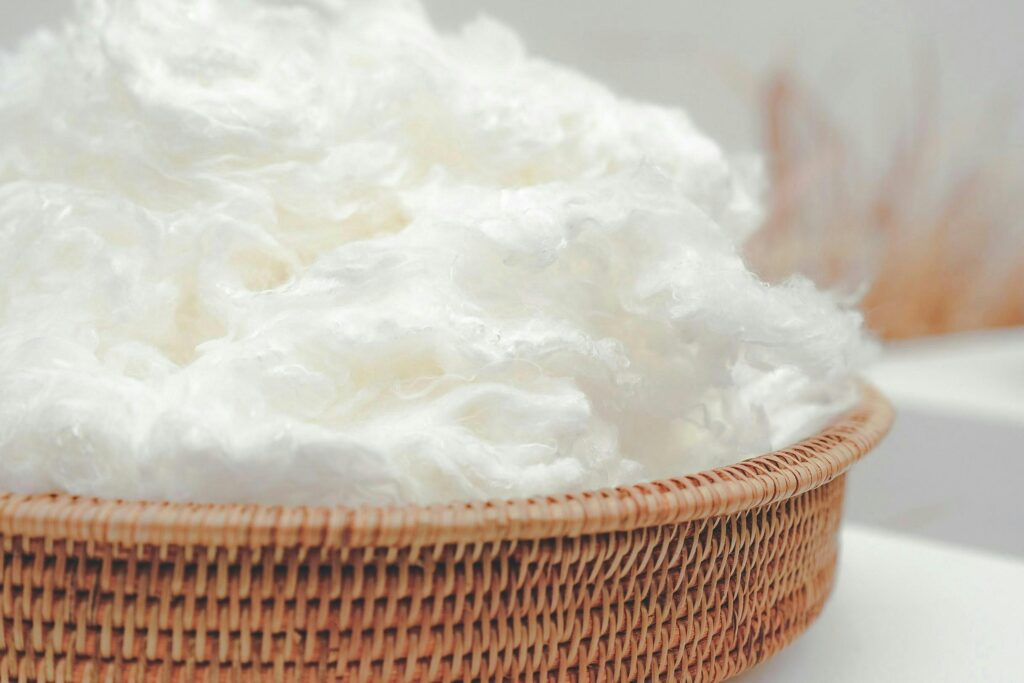
In another watershed decision, the government removed BIS norms on polyester fibre, polyester yarn and related intermediates. This creates a more open, innovation-friendly raw material environment for the MMF sector. Given that MMF accounts for nearly 70% of global textile consumption, India’s earlier restrictions hindered competitiveness against Bangladesh, Vietnam and China.
Impact of the reform:
- Eliminates India’s 10–20% raw material cost disadvantage
- Improves accessibility to speciality fibres needed for:
- performance textiles
- sportswear
- athleisure
- technical textiles
- Boosts innovation and upgradation across MSMEs
- Reduces imports of high-end MMF garments
- Strengthens India’s position in the PLI Scheme
Industry now seeks policy stability for at least 10 years to maximise investment confidence and achieve PLI-driven scale.
Moratorium & Export Realisation Extension: Immediate Relief Amid Global Turbulence
The US-imposed 50% tariff on Indian textile and apparel exports, combined with geopolitical disruptions, has significantly impacted orders, margins and liquidity. Production slowdown across decentralized powerloom and garment clusters has threatened employment and financial stability.
Recognising this, the government announced:
Key relief measures:
- Moratorium on term & working capital loan repayments from Sept 1 – Dec 31, 2025 (for apparel & made-ups)
- Extension of export realisation period from 9 months to 15 months
- Increase in maximum credit period for export finance from 1 year to 450 days
- Relaxation of bank margin requirements
These measures provide critical breathing space for exporters dealing with delayed shipments, cancellations and payment delays.
Industry associations, particularly SIMA, are urging the government to extend similar benefits to capital-intensive segments like spinning, weaving and processing to prevent NPAs and production collapse.
New Labour Codes: A Historic Modernisation of 29 Laws
The implementation of the four new labour codes from 21 November 2025 marks one of the most significant reforms in India’s manufacturing landscape.
The new codes include:
- Industrial Relations Code (2020)
- Code on Social Security (2020)
- Occupational Safety, Health & Working Conditions Code (2020)
- Code of Wages (2019)
These replace 29 outdated legislations and modernize India’s labour environment for the next generation.
What textile industry gains:
- Flexible working hours and streamlined fixed-term employment
- Single licence, single registration, and pan-India compliance
- Mandatory health check-ups and appointment orders
- Encouragement of safe employment for women workers
- Improved social security and transparency
These changes will help India align with global norms such as the EU Corporate Sustainability Due Diligence Directive (CSDDD)—a prerequisite for long-term export competitiveness.
PLI Scheme Expansion: 17 New Applicants Approved
The approval of 17 new applicants under Round 3 of the PLI Scheme reflects continued momentum in MMF apparel, technical textiles and value-added fabrics.
Scheme impact overview:
- ₹2,374 crore of fresh investment committed
- Projected sales of ₹12,893 crore
- Employment for over 22,646 people
With a total outlay of ₹10,683 crore, the scheme aims to build globally competitive scale in MMF and technical textiles—two areas where India has long lagged behind.
The reopening of applications until December 31, 2025 signals the government’s intent to broaden participation and accelerate value chain transformation.
Export Growth to 111 Countries: India’s Resilient Diversification Story
Despite tariff shocks, inflationary pressures and weakened demand in key markets, India’s textile and apparel exports grew marginally in April–September 2025, supported by significant diversification.
Exports to 111 countries grew by 10%, contributing USD 8.49 billion, compared to USD 7.72 billion last year.
Markets showing strong growth:
- UAE – 14.5%
- Japan – 19%
- Spain – 9%
- France – 9.2%
- Egypt – 27%
- Saudi Arabia – 12.5%
- Hong Kong – 69%
Top-performing sectors:
- Ready-made garments – 3.42% growth
- Jute – 5.56%
This diversification aligns with the government’s push to expand exports to 100+ new global markets, reducing over-dependence on the US and EU.
A Pivotal Moment for India’s Textile Future
The convergence of these reforms—industrial, financial, export-focused, labour-related and investment-driven—marks an unprecedented shift in India’s textile policy landscape.
Collectively, they aim to address deep-rooted structural challenges while unlocking new opportunities in MMF, technical textiles, circularity, sustainability and global market access.
If supported by long-term policy stability and continuous industry–government collaboration, these reforms could position India as:
- A global leader in MMF and performance textiles
- A preferred sourcing destination for sustainable apparel
- A competitive alternative to China, Vietnam and Bangladesh
- A USD 100 billion textile exporter by 2030
- A key contributor to Viksit Bharat @2047
The message is clear: Indian textiles are preparing for their next leap. The foundation has been laid. The next decade will reveal how industry players build upon it—with innovation, investment, resilience and global ambition.

“CITI is very thankful to the Ministry of Textiles for rescinding the Quality Control Order on VSF. Viscose staple fibre and several speciality fibers within this order are critical inputs for several value-added garments and made ups. This, along with the earlier rescinding of the QCO on polyester yarn and fibres, will address the price and availability concerns raised by the users of these raw materials in the MMF segment. This measure will contribute significantly to raising the competitiveness of the Indian textile and apparel sector,” CITI Chairman Shri Ashwin Chandran.

Mr. Durai Palanisamy, Chairman of the Southern India Mills’ Association (SIMA), “This path-breaking reform marks a significant milestone in positioning India as a global hub for man-made fibre (MMF)-based textiles and apparel. Mr. Durai further added that the removal of the QCO on Terephthalic Acid and Ethylene Glycol, the key raw material for manufacturing polyester fibre, is a welcome step that will enhance raw material availability and competitiveness. Overall, the removal of these QCOs is expected to pave the way for accelerated growth across the MMF textile value chain, encompassing yarns, fabrics, garments, made-ups, and technical textiles.