India’s textile processing sector is undergoing rapid transformation as manufacturers seek advanced technologies to improve fabric quality, handle increasingly complex materials, and enhance operational efficiency. Processing hubs such as Tirupur—one of the world’s largest knitwear clusters—are at the center of this evolution, driving demand for sophisticated dyeing and finishing equipment.
Swiss textile machinery manufacturer Benninger AG has been a long-standing partner to the Indian textile industry, offering solutions across continuous and discontinuous processing technologies. With decades of engagement in India and a growing manufacturing base in the country, the company continues to expand its technological footprint.
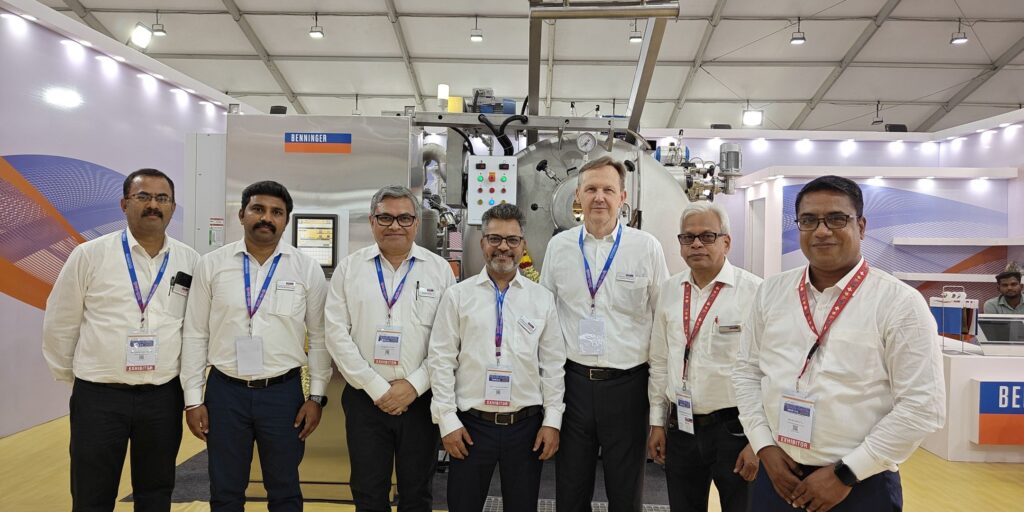
At the Knit Tech Exhibition, representatives from Benninger—including Thomas Widmer, Bikram Saha, and Laxmansa Katwa—shared insights on the importance of the Tirupur market, the company’s latest innovations in discontinuous processing, and the growing role of Benninger India in global manufacturing.
Tirupur: A Strategic Market for Advanced Processing Solutions
Tirupur has emerged as one of the most important markets for textile processing machinery in India due to its massive knitwear production base and large concentration of dyeing and finishing units.
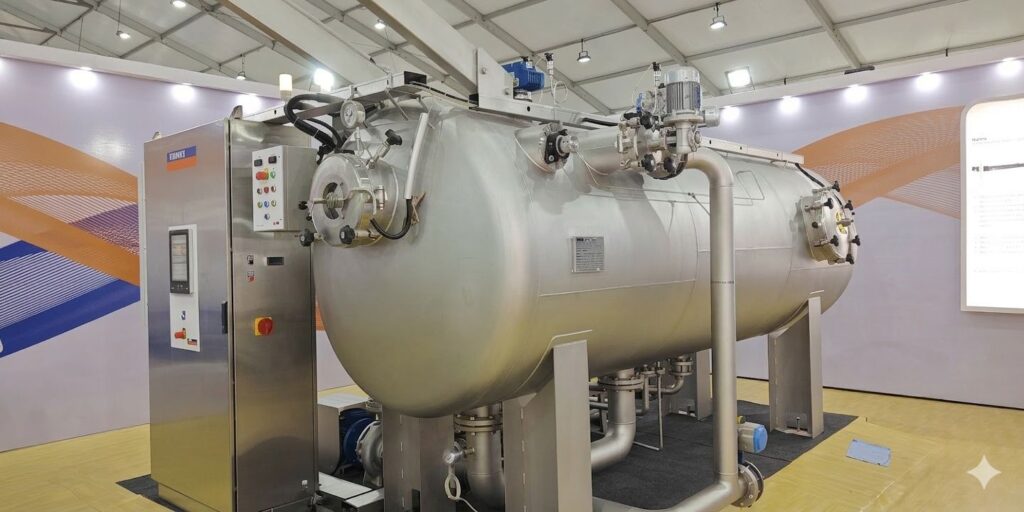
For Benninger, this cluster represents a key opportunity. The company offers a broad range of machinery suited to the needs of knitwear processors—from continuous processing technologies such as washing ranges, bleaching lines, mercerizing systems, singeing machines and cold pad batch (CPB) dyeing units, to advanced discontinuous processing machines such as softflow and jet dyeing machines for delicate fabrics.
With the increasing diversification of fabrics processed in Tirupur—including polyester blends, synthetic materials, and elastane-containing textiles—processors are seeking machines capable of handling these materials without compromising fabric quality. Benninger’s product portfolio is designed precisely to meet these evolving requirements.
Advancing Discontinuous Processing Technologies
One of the key highlights at the exhibition was Benninger’s solution for discontinuous fabric processing, particularly machines designed to handle delicate and crease-prone fabrics.
Traditional jet or soft-flow dyeing machines typically process fabric in rope form within round chambers. While widely used, these systems can create defects such as rope marks or crease marks under certain conditions.
Benninger’s long-tube processing technology addresses these challenges by allowing the fabric to be processed in a more controlled environment. Instead of compressing the fabric inside a circular chamber, the machine allows it to move across a longer path with minimal tension and pressure.
This approach is particularly beneficial for delicate fabrics and modern synthetic materials that are increasingly common in the knitwear sector.
Eliminating Fabric Defects Through Smart Engineering
Two of the most common defects encountered in rope processing are rope marks and crease marks—each caused by different mechanical factors.
Rope marks occur when the fabric is not sufficiently opened during processing, allowing chemicals or dyes to remain trapped within folds. Crease marks, on the other hand, result from prolonged pressure on the fabric while it remains in a compressed state.
Benninger’s machine design addresses both issues through several key innovations:
- Low fabric tension: The machine maintains extremely low stretch between the chamber and the winch, significantly reducing fabric stress.
- Flat processing path: By extending the machine length, the fabric moves across a flatter path rather than being compressed in a circular chamber.
- Controlled fabric plating: The system carefully lays the fabric into the chamber, ensuring correct orientation and preventing tangling or knot formation.
- Self-cleaning filtration systems: Integrated filtration ensures consistent chemical circulation and minimal contamination.
- Optimized fabric transport: A large wrap angle enhances the fabric transport mechanism, improving both speed and operational stability. The automatic nozzle and inclined intensive tube greatly reduces the possibilities of rope marks.
These engineering features collectively improve processing quality while reducing the risk of defects.
Benninger’s Long-Standing Presence in India
Benninger’s association with India dates back several decades. The company initially entered the market through a joint venture before becoming a fully independent entity.
Over the years, the company has built a strong installed base across the country, with more than 200 installations in textile processing units.
Benninger India has evolved significantly during this period. Initially focused on manufacturing components such as rollers, the Indian operation gradually expanded into producing larger machine components that were supplied to the headquarters for final assembly.
In recent years, the company has taken a major step forward by introducing discontinuous processing machines manufactured in India. Despite early challenges—including the disruptions caused by the COVID-19 pandemic—the segment has begun gaining traction with several successful installations already in operation.
Increasing Localization and Global Supply from India
A major milestone for Benninger India has been the localization of machine manufacturing. Today, roughly 80 percent of the value of certain machines is produced locally, combining Swiss engineering with Indian manufacturing capabilities.
Importantly, machines manufactured in India are no longer limited to the domestic market. Having achieved the required quality standards, Benninger now exports machines produced in India to global markets. Several installations manufactured entirely in India have already been successfully delivered overseas, demonstrating the facility’s capability to meet international expectations.
This shift reflects a broader strategic change within the company—from using India purely as a supply base for the local market to positioning it as a global manufacturing hub.
Engineering Expertise and Strong R&D Support
Benninger’s competitive strength lies not only in manufacturing but also in the depth of its engineering and research capabilities. The company has built decades of technical expertise in textile finishing technologies.
With dedicated research and development teams across multiple locations, the company continues to refine its product portfolio. The knowledge accumulated over more than a century of engineering experience enables Benninger to design machines that remain reliable and efficient over long operational lifecycles.
This long-term reliability is particularly important in textile processing, where machines typically operate for many years and the total lifecycle cost often exceeds the initial purchase price.
Advanced Manufacturing Technologies at Benninger India
Benninger India is also investing heavily in advanced manufacturing technologies to strengthen its production capabilities.
The facility has introduced modern fabrication systems such as laser welding and robotic welding technologies to ensure consistent quality, precision, and repeatability in machine manufacturing.
These technologies not only improve production efficiency but also enable the company to achieve the high-quality standards expected from Swiss-engineered machinery.
The company’s operations in India currently employ a large workforce in manufacturing and administration, along with a dedicated service team that supports customers across both continuous and discontinuous textile processing technologies.
India’s Growth Potential in the Global Textile Landscape
From Benninger’s global perspective, India represents one of the most promising textile markets in the coming decades.
The country’s large population, expanding domestic consumption, and strong export-oriented textile sectors provide significant growth opportunities. Unlike several developed markets facing demographic challenges, India’s young workforce and expanding industrial base position it well for sustained growth.
Segments such as apparel, knitwear, and home textiles continue to expand, supported by increasing exports and favourable trade agreements. These trends are expected to drive further demand for advanced textile processing technologies.
Future Plans: Expanding Product Localization
As the Indian textile industry continues to modernize, demand for high-quality processing technologies will only increase. In this evolving landscape, Benninger’s long-standing presence, strong engineering capabilities, and growing manufacturing base in India position the company well to support the industry’s next phase of growth.
Benninger is a leading global machinery manufacturer producing textile processing machines in India, supporting the Government of India’s Make in India initiative.
By integrating Swiss engineering excellence with localized production and service capabilities, Benninger is not only strengthening its foothold in key textile clusters such as Tirupur but also establishing India as a strategic hub for global manufacturing and innovation.