The textile industry is entering a decisive decade where competitiveness will be defined not by scale or cost alone, but by carbon intensity. This transition is structural, not ideological.
At successive climate summits under the United Nations Framework Convention on Climate Change (UNFCCC), particularly COP28, governments reinforced commitments to accelerated decarbonization. Simultaneously, mechanisms like the European Union’s Carbon Border Adjustment Mechanism (CBAM) make carbon intensity a determinant of market access.
For export-driven textile economies, carbon is no longer a peripheral sustainability metric; it is a trade variable. In this context, carbon credits are not indulgences but instruments of accountability. One credit represents the verified reduction of one metric ton of CO₂. When industries cut emissions below a defined baseline, those reductions can be measured, audited, and transformed into tradable carbon assets.
For the textile sector, the opportunity lies not in buying offsets, but in generating real, technology-driven reductions.
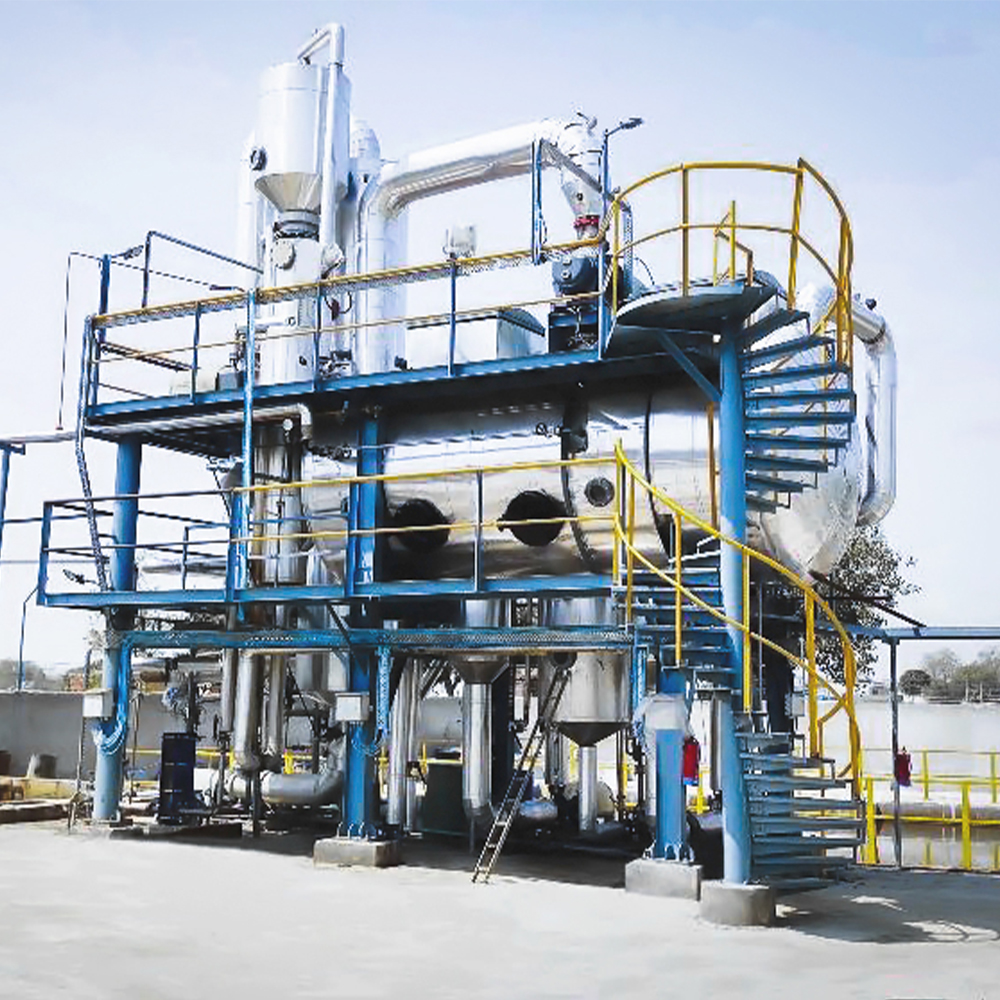
Consider a 100 KLD textile Zero Liquid Discharge (ZLD) plant operating at 10,000 ppm TDS, for 330 days a year considering electricity tariff Rs.8/kWh ZLD systems are energy-intensive by design. The technological pathway chosen within ZLD therefore determines whether compliance becomes a carbon liability or a climate asset.
Energy & Operating Profile
| Parameter | MEE System | MVR System |
| Primary energy source | Coal-fired steam | Electricity |
| Steam consumption | 0.30–0.35 T/m³ | Nil |
| Power consumption | Minimal auxiliary | 10–15 kWh/m³ |
| Operating cost | ~₹0.90 per liter | ~₹0.17 per liter |
| Annual CO₂ emissions | 2600-3000 tCO2 | 550–650-tCO2 |
| Net CO₂ reduction | – | ~2050 tCO₂/year |
| Carbon credits generated | – | ~2050 credits/year |
Carbon Credit Value & Financial Impact
| Item | Value |
| Carbon credits generated | ~ 2050 credits/year |
| Voluntary market price | ~₹400 per tCO₂ |
| Annual carbon credit revenue | ~ ₹ 8.2 lakh |
| Additional OPEX savings vs MEE | ~₹ 2.4-2.41 Cr/year |
The numbers speak clearly. A single mid-sized textile plant can eliminate more than 78% of its CO2 emissions by transitioning from steam driven evaporation to Mechanical Vapor Recompression (MVR) based Low Temperature Evaporation Technology (LTE®). This is not marginal improvement, it is structural decarbonization.
At prevailing voluntary market prices, 2050 carbon credits per year create additional revenue. Yet the financial return is secondary to the strategic signal: the enterprise has reduced emissions at source. In a world shaped by CBAM, climate disclosures, ESG-linked financing, and science-based targets, this distinction matters profoundly.
The industries adopting this sustainable approach using advanced, low-energy, zero-emission wastewater technologies are increasingly receiving:
- Priority approvals for expansion
- Faster environmental clearances
- Preference under green procurement policies
- Access to green loans and climate-finance schemes
India’s upcoming Carbon Credit Trading Scheme (CCTS), along with international mechanisms like VERRA, Gold Standard, Certified Emission Reductions (CERs), and Global Carbon Council Credits (GCC), offers new revenue opportunities for industries adopting clean technologies.
A zero-emission wastewater treatment plant can also qualify for prominent global certifications:
- ISO 14001 – Environmental Management
- ISO 50001 – Energy Management
- LEED & IGBC ratings
- ESG and GRI compliance
The coming decade will embed carbon accounting into global procurement. International brands will assess suppliers not only on price and quality, but on emissions intensity per unit output, while capital markets will increasingly favor low-carbon operations.
Carbon credits, when backed by genuine technological transformation, offer two clear advantages: they monetize decarbonization and demonstrate measurable alignment with global climate commitments.
Sustainability is no longer a parallel agenda; it is industrial strategy. The textile manufacturer of the future will integrate energy efficiency, electrification, digital automation, and transparent carbon accounting into core engineering decisions. Climate policy is already reshaping trade. The real question is whether we respond reactively or lead proactively.
With its engineering depth and global integration, the textile sector is positioned to lead. Technologies such as MVR-based ZLD show that environmental responsibility and economic resilience can reinforce each other. Carbon credits are not the destination, but the bridge to a sustainable industrial future, one that will reward transformation over mere compliance.