As textile manufacturers increasingly focus on efficiency, quality consistency, and waste reduction, real-time inspection technologies are becoming essential across production processes. In knitting, where high-speed machines process large volumes of yarn every hour, even a minor defect can quickly translate into significant material losses if not detected immediately. Conventional inspection systems often struggle to identify subtle defects, particularly those related to elastane or structural variations in the knitted fabric.
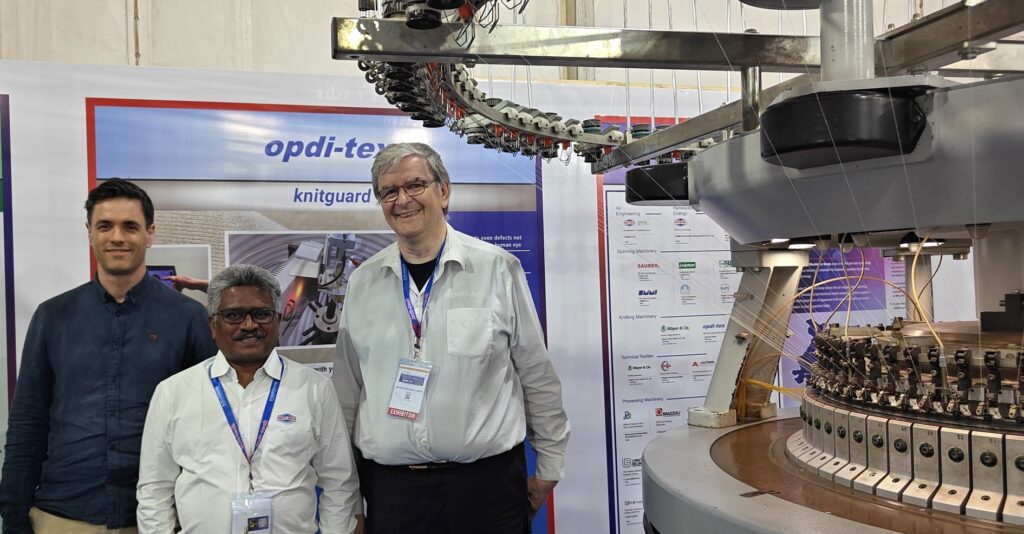
Addressing this challenge, opdi-tex, founded by Mr. Karl Ludwig Schinner, has developed an advanced AI-driven machine vision solution for circular knitting machines. Marketed under the brand KnitGuard, the system performs real-time, contactless inspection directly inside the knitting machine, identifying defects within seconds of formation. With Batliboi Textile Machinery Group supporting the technology’s introduction in India, the solution is gaining attention from knitters seeking to improve quality control, reduce waste, and move toward fully digitized knitting operations.
From Vision Inspection Expertise to Textile Innovation
The journey of KnitGuard reflects decades of experience in machine vision technologies. Mr. Karl Ludwig Schinner founded opdi-tex in July 2000 with the objective of developing on-loom inspection systems for textile production. Dr. Mattias Träger joined the leadership team at opdi-tex as Managing Partner, bringing renewed energy and strategic direction to the organization as part of a planned succession. Together with a dedicated team, he continues to strengthen the company’s long-term commitment, ensuring the continued delivery of high-precision German engineering, reliable solutions, and lasting value to customers in the textile industry.
Early work focused on weaving applications, where vision systems were designed to detect defects directly on the loom.
Over time, the technology evolved through collaborations with several European companies. However, the rapid advancements in AI, intelligent cameras, and high-performance computing platforms opened new opportunities for more sophisticated inspection solutions.
Recognizing this potential, opdi-tex began developing a new generation of inspection technology specifically tailored for circular knitting machines. The result was an intelligent system capable of detecting structural deviations in knitted fabrics in real time, marking a significant leap forward in knitting quality control.
KnitGuard: Real-Time AI-Based Inspection Inside the Knitting Machine
The system initially known as Knithawk has now been rebranded as KnitGuard, representing a new phase in the technology’s development and commercialization.
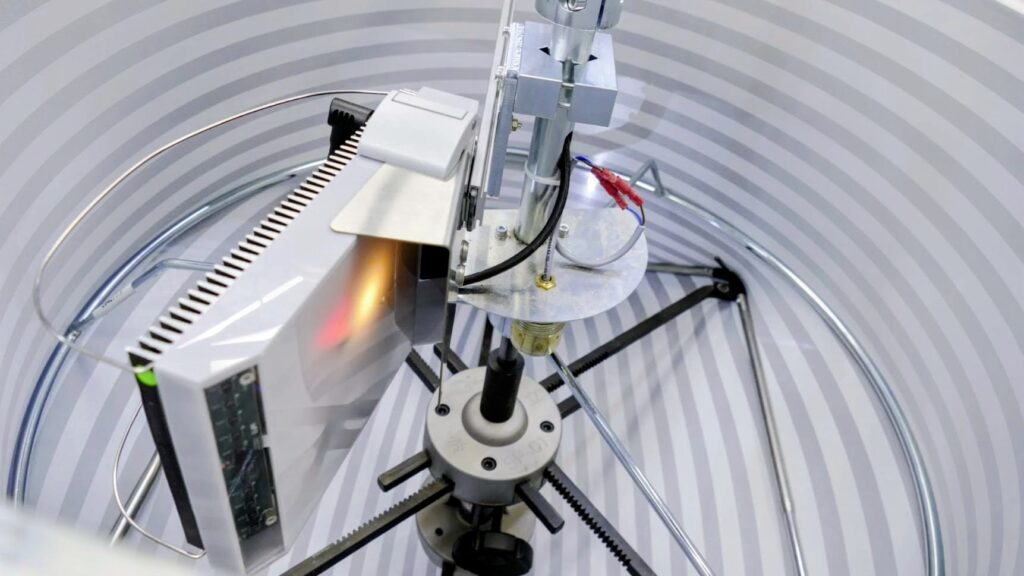
Unlike traditional scanners that inspect fabric after it leaves the knitting zone, KnitGuard operates directly inside the circular knitting machine, continuously monitoring the fabric structure during production. Using a high-resolution camera positioned within the machine, the system observes the inner surface of the knitted fabric without physical contact.
Before production begins, the system undergoes a short training phase. During this process, it learns the correct fabric structure for the specific article being produced. Once trained, the AI-powered software continuously compares the live fabric structure with the reference pattern and identifies deviations instantly.
The system can classify different types of defects, including vertical defects, horizontal defects, and spot defects. Most importantly, it can detect structural deviations caused by Lycra or elastane irregularities, like misplating, which are often difficult for conventional systems, competitor products or even experienced operators to identify during production.
In situations where a defect is detected, the system can automatically send a signal to the knitting machine to stop production, preventing further fabric waste.
Detecting Critical Defects Invisible to the Human Eye
One of the most significant advantages of the KnitGuard system is its ability to identify defects that are almost impossible to detect during normal production conditions.
For example, if a filament within an elastane yarn breaks, the effective yarn denier changes. While this may not be visible in the grey fabric during knitting—especially when the fabric is under tension—the structural variation can lead to defects that only become apparent during later processing stages.
By detecting these variations within the first few centimeters of fabric formation, KnitGuard prevents the production of large quantities of defective fabric. This early detection capability significantly reduces material waste and eliminates the risk of defects progressing unnoticed through downstream processes such as dyeing and finishing.
Data Transparency and Digital Quality Documentation
Beyond defect detection, KnitGuard also functions as a digital quality monitoring platform.
The system automatically generates detailed quality reports for each roll of fabric produced. These reports can be customized to track performance metrics by machine, shift, or production batch. The data can be exported in digital formats and shared directly with management teams.
Operators can monitor the system through a tablet interface installed on the knitting machine. In addition, the data can be accessed through a centralized dashboard running on a local computer or cloud platform, allowing factory managers to monitor production remotely.
This level of transparency enables knitters to track machine performance, analyze defect patterns, and implement corrective measures quickly.
Retrofit-Friendly Technology for Existing Knitting Machines
One of the key strengths of the KnitGuard system is its flexibility in installation.
Although initially developed in collaboration with Mayer & Cie circular knitting machines, the technology is not limited to any specific machine brand. It can be installed on virtually any circular knitting machine, including machines from manufacturers such as Santoni, Terrot, Pailung, and others.
The system is designed for easy retrofitting. Installation involves mounting the camera unit inside the machine and connecting the system to the machine control through a simple interface box. Since the system primarily requires rotation signals and stop commands from the machine controller, integration is relatively straightforward.
This flexibility allows both new machines and older installed machines to benefit from the technology.
Industry Adoption and Early Installations in India
India has emerged as one of the early markets where the technology is being introduced in collaboration with Batliboi Textile Machinery Group, a long-established partner for circular knitting technology in the region.
Several initial installations have already been completed at leading knitting facilities. Companies such as KPR Mills have adopted the system, with installations covering both existing machines and newly delivered equipment.
According to Mr. S. Rakkimuthu, Deputy General Manager at Batliboi Textile Machinery Group, the interest among knitters is driven primarily by the growing need to reduce fabric wastage and improve process reliability.
Conventional infrared-based scanners commonly used on knitting machines are capable of detecting certain defects such as holes or needle breaks. However, they often struggle to detect elastane-related defects or subtle structural variations as well as yarn density variations.
By leveraging high-resolution camera imaging and artificial intelligence, KnitGuard provides a more comprehensive inspection capability.
Reducing Waste and Improving Production Efficiency
Fabric waste remains a major concern for knitting manufacturers. According to industry estimates shared during the discussion, conventional inspection systems can still allow 2 to 3 percent fabric wastage due to undetected defects.
By identifying defects at the earliest stage of production, KnitGuard has the potential to reduce this wastage dramatically. Early feedback from customers suggests that the technology could bring defect-related waste down to less than half a percent, representing a significant improvement in production efficiency.
For manufacturers using expensive yarns or producing high-value fabrics, the financial impact of this reduction can be substantial. In many cases, the return on investment for the system can be achieved in less than two years, and in situations where large defect batches are prevented, the payback period can be even shorter.
Toward the Future of Smart Knitting Factories
Looking ahead, the developers see machine vision systems becoming a standard component of knitting machines.
As AI-driven quality monitoring technologies mature, knitting machines are expected to incorporate increasingly advanced inspection capabilities directly into their production workflow. The vision is to create fully digital knitting environments where quality control is performed automatically and continuously during production, reducing the need for extensive manual inspection after knitting.
The KnitGuard platform itself will continue to evolve, with future developments focusing on improved usability, enhanced reporting capabilities, and expanded compatibility with smaller machine diameters and specialized applications.
The technology also holds potential beyond apparel fabrics, including technical textile applications such as automotive fabrics and safety materials like airbag fabrics, where quality consistency is critical.
The emergence of AI-driven machine vision systems such as KnitGuard represents a significant step forward in knitting technology. By bringing real-time quality inspection directly into the knitting machine, manufacturers can detect defects earlier, reduce material waste, and improve production transparency. A key specialty of KnitGuard is that training occurs on the machine itself. There is no need for a cloud connection; the internet is used only for the upgradation of features, ensuring that no critical production data is transferred to a cloud.
With the combined expertise of opdi-tex in machine vision technologies and Batliboi Textile Machinery Group’s deep understanding of the knitting industry, the solution is gaining momentum in key textile markets such as India.
As the industry moves toward smarter, more automated production environments, technologies like KnitGuard are likely to play a crucial role in shaping the next generation of intelligent knitting factories, where quality assurance is embedded directly within the manufacturing process.