Why long-term performance and operating economics matter more than initial investment
For decades, Zero Liquid Discharge (ZLD) in the textile industry has been approached largely as a regulatory necessity, an unavoidable cost of operating in a water-stressed and compliance-driven environment. However, as global textile value chains face intensifying pressure from water scarcity, carbon regulation, and Environmental, Social, and Governance (ESG) driven procurement, this perception is no longer sustainable. Today, ZLD must be evaluated not as an environmental add-on, but as a strategic utility that directly influences operational resilience, cost competitiveness, and long-term business viability.
The textile sector is inherently water-intensive, generating complex effluent streams from dyeing, washing, printing, and finishing operations. A reliable ZLD system ensures water security, protects production continuity, and reduces long-term dependence on external freshwater sources. Yet, investment decisions continue to be guided predominantly by initial capital cost. This short-term lens often results in systems that technically comply with discharge norms but fail to deliver economic or operational sustainability over their design life.
Rethinking Cost Economics: Conventional vs MVR based LTE® System
Conventional ZLD systems are often selected for their lower upfront cost, yet this captures only a fraction of their true economic impact. In steam-based configurations, long-term expenses related to fuel, energy, chemicals, maintenance, and unplanned downtime quickly outweigh initial capital savings. Continuous high-temperature operation accelerates scaling, fouling, and corrosion, while boiler-dependent utilities add complexity and cost, steadily eroding profitability and reliability over the plant lifecycle.
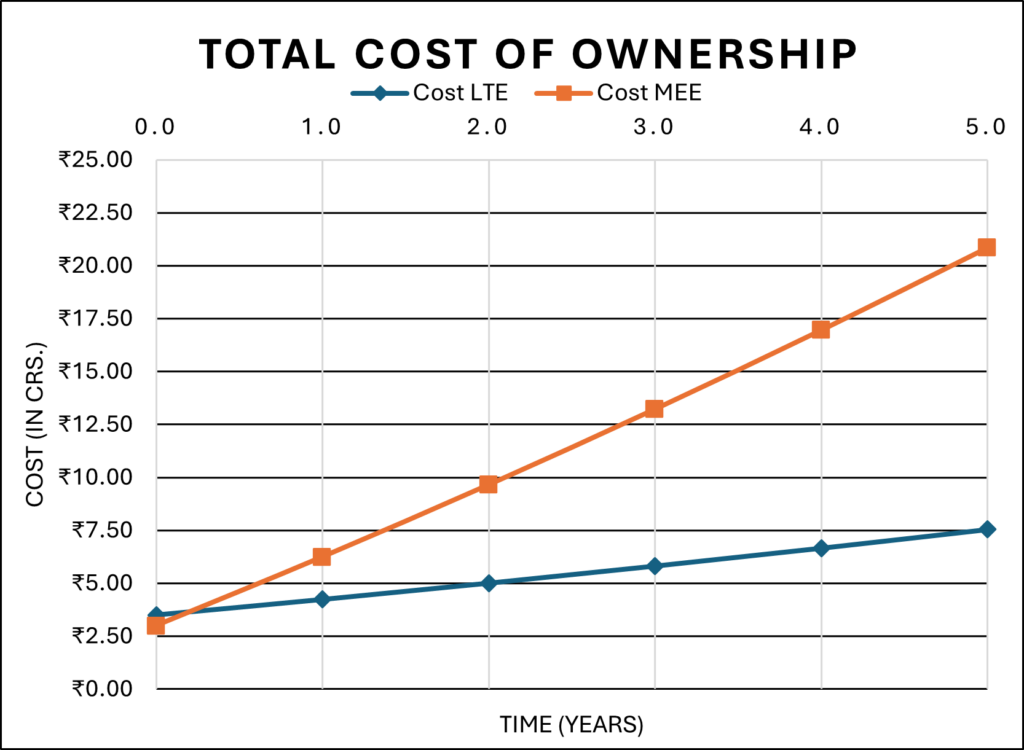
ROI Graph – MVR Based LTE® vs MEE System
As industries shift from short-term savings to lifecycle economics, Mechanical Vapor Recompression (MVR) based ZLD systems are emerging as a more robust and future-ready alternative.
SED’s MVR based low temperature evaporator (LTE®) systems fundamentally change the cost structure by eliminating external steam through vapor recompression, reducing operating costs by up to 75%. For a 100 KLD ZLD plant, a conventional system may start at ~₹3 crore, while an MVR based LTE® system costs ~₹3.5 crore. But within five years, cumulative cost for the conventional system rises to ~₹21 crore, whereas MVR based LTE® remains limited to ~₹7.5 crore, delivering a ~65% lower total cost of ownership. The investment pays back within 1.5 years, driven by almost zero steam consumption, reliable high uptime, low utilities, no pretreatment, and a fully automated system requiring minimal manpower.
From an operational perspective, LTE® systems operate under vacuum at low temperatures, significantly reducing scaling, fouling, corrosion, and thermal stress, resulting in longer equipment life. While conventional ZLD systems may minimize initial investment, the lifecycle cost curve clearly shows that MVR based LTE® delivers lower operating risk and superior economics over the plant’s lifetime.
The environmental dimension further strengthens the case. Fuel-fired boilers remain a major source of carbon dioxide (CO₂), acid gases, particulate matter, ash, and high total dissolved solids (TDS) blowdown, often becoming the limiting factor in meeting tightening pollution control norms. MVR-based LTE systems eliminate combustion-related emissions altogether, supporting ESG disclosures, internal carbon reduction targets, and future carbon credit mechanisms. When powered by renewable electricity, such as solar or wind energy, they enable near-zero-emission or Green ZLD operations with zero operational cost.
A Smarter Evaluation Approach
A lifecycle-focused evaluation shifts the question from “How much does it cost to build?” to “How much does it cost to run reliably?” For leadership, the priority is no longer the lowest installation cost, but the system that delivers the lowest risk, lowest operating cost, and highest reliability over decades. Organizations that evaluate ZLD through energy efficiency, adaptability, maintainability, and environmental performance consistently outperform those focused only on capital cost. In an evolving regulatory and sustainability landscape, ZLD must be treated as long-term infrastructure rather than short-term compliance. Systems that secure water availability, control operating costs, and future-proof textile manufacturing create lasting competitive advantage, making lifecycle-driven, energy-efficient ZLD solutions a strategic investment, not an expense.