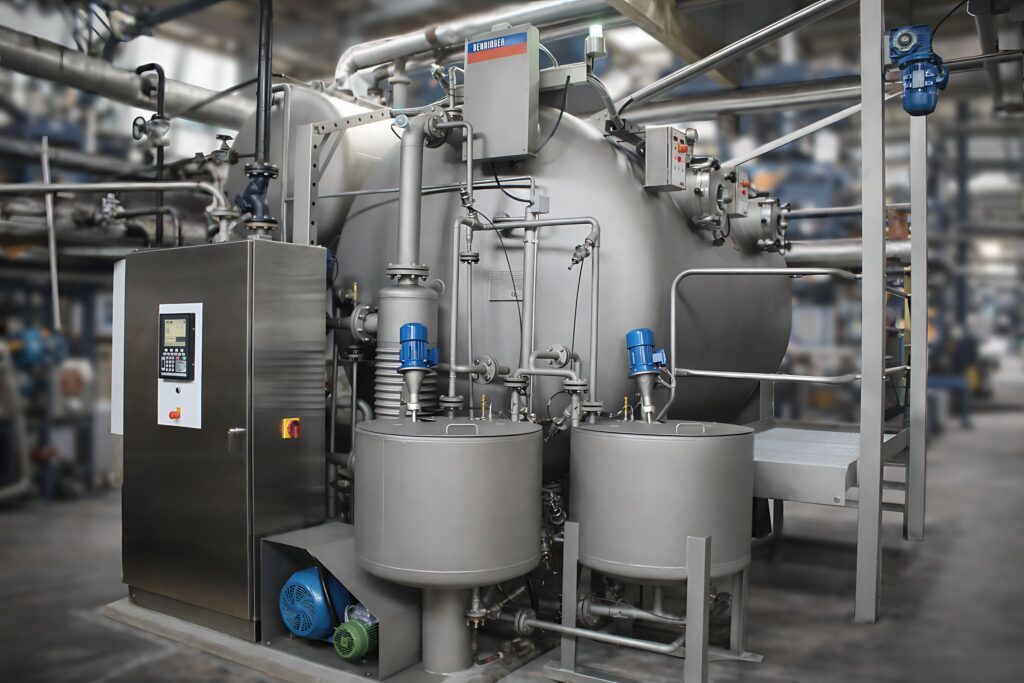
For anyone familiar with the global textile machinery landscape, Benninger is a name that needs little introduction. The Swiss major has, for decades, remained at the forefront of innovation in fabric preparation, dyeing, and finishing technologies, consistently setting benchmarks in efficiency, fabric care, and sustainability. In recent years, Benninger has further strengthened its presence in India with the FabricMaster soft flow dyeing machine, which is increasingly being recognized as a game-changing solution by textile processors across the country.
Adding to this momentum is the fact that the FabricMaster is now being manufactured at Benninger’s state-of-the-art production facility in Pune, underscoring the company’s long-term commitment to the Indian textile industry and to localized manufacturing.
FabricMaster: A New Benchmark in Soft Flow Dyeing
Designed to address the evolving requirements of modern textile processing, the FabricMaster combines gentle fabric handling with high productivity and strong sustainability credentials. Its growing acceptance among Indian dyeing units reflects the industry’s need for equipment that can efficiently process delicate and stretch fabrics without compromising quality.
One of the notable Indian success stories for the FabricMaster is Amarnath Dyeing and Bleaching Works Private Limited, where two of these machines are currently operational and delivering consistent performance.
Amarnath Dyeing: Built on Scale and Integration
Located in Howrah, West Bengal, Amarnath Dyeing has an installed processing capacity of 30 tonnes per day and operates as part of the well-established Siddheswari Group. The group has developed a strong vertically integrated manufacturing ecosystem, with modern facilities covering knitting, dyeing, processing, printing, and garmenting.
Established in 1990, Amarnath Dyeing has built a reputation for robust infrastructure and a proactive approach to technology adoption. The company’s management has consistently focused on upgrading machinery and processes in line with global best practices—an approach that ultimately led it to explore advanced soft flow dyeing technologies.
The Start of the Benninger Association
“The association started just after the pandemic,” recalls Sudarshan Chandak, Director, Amarnath Dyeing and Bleaching Works Private Limited. “We had been using dyeing machines of other leading brands. Around 2022, we began hearing positive feedback about the FabricMaster. The Benninger team got in touch with us, we evaluated the machine, and it impressed us on several fronts.”
Based on this assessment, the company initially installed a FabricMaster machine, followed by another, as confidence in the technology grew.
Low Winch Height, Low Tension: A Critical Advantage
In a market with several competing options, Sudarshan points to one decisive technical advantage. “One of the principal reasons for choosing the FabricMaster was its low winch height. A lower height means significantly less tension on the fabric, which is extremely important when processing spandex fabric, the main category we handle today.”
Reduced fabric tension leads to lower elongation and better fabric integrity—critical quality parameters in modern dyeing operations. The FabricMaster’s large wrapping angle at the winch further minimizes tension, ensuring gentle and uniform fabric movement throughout the dyeing cycle.
Productivity and Quality Gains on the Shop Floor
Beyond fabric care, the FabricMaster has also delivered tangible operational benefits. “We have seen a clear improvement in overall productivity,” Sudarshan explains. “The machine saves considerable time and utilities compared to our earlier equipment. Reduced cycle times directly translate into more economical production.”
At the same time, the machine scores high on quality parameters such as dye penetration and colour consistency, ensuring uniform results across batches—an essential requirement for customers with demanding quality standards.
Damage Prevention through Smart Design
Another feature that strongly influenced the decision was the absence of rubber slata on the winch. “This helps prevent fabric damage such as permanent abrasion, creases, or rope marks, especially in delicate fabrics,” Sudarshan notes.
Instead, the FabricMaster uses a hydrodynamic drive-based fabric transport system, incorporating specially designed nozzles and an internal plaiter. This ensures smooth fabric circulation, uniform dye penetration, and minimal mechanical stress during processing.
Sustainability as a Built-In Benefit
Sustainability considerations have become central to investment decisions in textile processing, and the FabricMaster aligns well with these priorities. “We are saving water on this machine,” says Sudarshan. “The optimized chamber design results in a low liquor ratio, which has made a noticeable difference.”
The combination of low liquor ratio and harmonious system design enables exceptionally low consumption of water, energy, and chemicals, reinforcing Benninger’s position as a technology partner committed to sustainable textile manufacturing.
Scaling Up with FabricMaster
Encouraged by the strong performance of the two installed units, Amarnath Dyeing is already planning the next phase of expansion. “Yes, we have plans to add another FabricMaster and dye house automation systems,” Sudarshan shares. “Hopefully, as market conditions return to normal, we should see it becoming part of our factory in the near future.”
As Indian textile processors increasingly seek solutions that balance productivity, fabric quality, and sustainability, success stories like Amarnath Dyeing’s highlight why Benninger’s FabricMaster is steadily emerging as a preferred choice in modern dyeing operations.