India has emerged as a vital growth engine in the global spinning industry, and for Saurer, a pioneer in textile machinery, the country plays a central role in its future roadmap. With a robust manufacturing base in Karjan, a deep commitment to customer-centricity, and a strong focus on automation, digitalization, and sustainability, Saurer is aligning its innovations with the evolving needs of Indian spinners.

In this exclusive interview, Mr. Hailin Xu, CEO of Saurer, shares insights on the company’s strategic priorities in India, the launch of its latest technologies including the Zinser 51 and Autocoro 11 Recycling Xtreme, and how Saurer is transforming from a machinery maker into a full-spectrum solutions provider to help Indian textile manufacturers stay competitive in a dynamic global landscape.
Saurer’s Strategic Presence in India
India is the world’s second-largest spinning market, and Saurer already has a robust manufacturing base in Karjan. How do you view the strategic importance of the Indian market in Saurer’s global roadmap, especially in light of your recent visit?
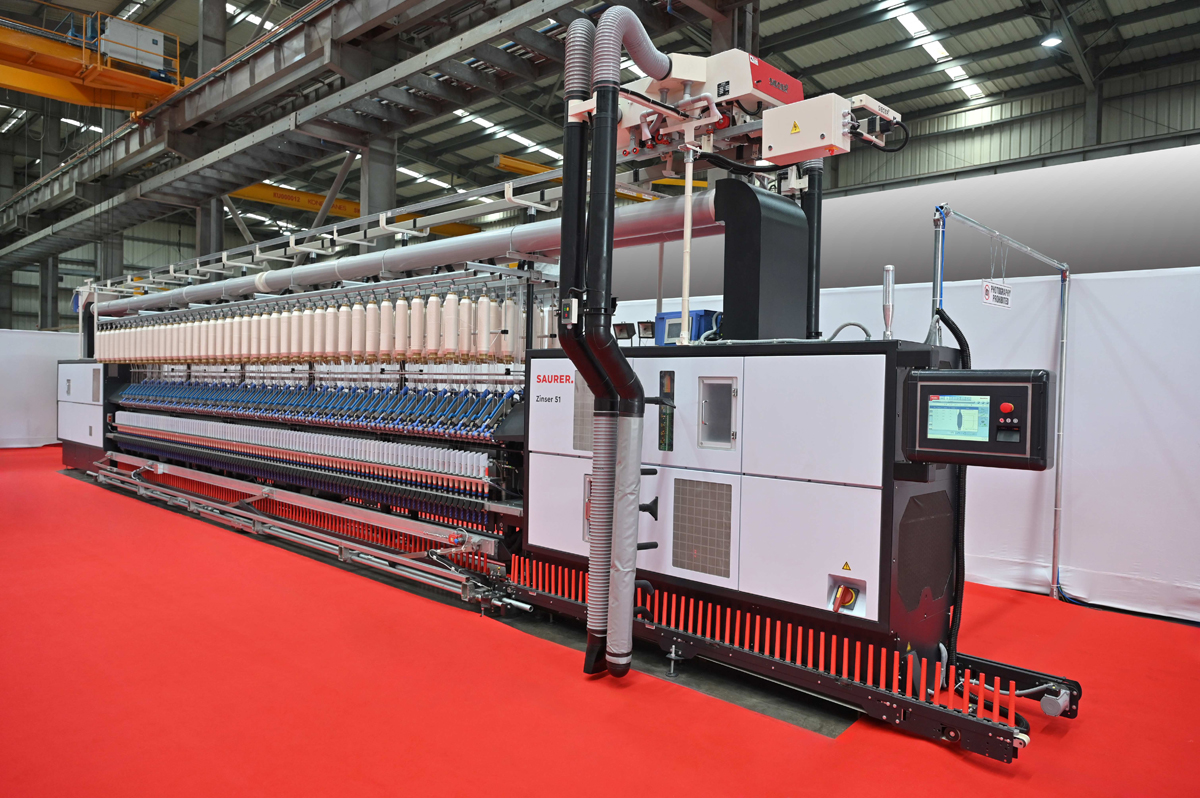
India stands as the second largest ring-spinning market globally and boasts the fastest spinning speeds worldwide. Additionally, India plays a pivotal role in recycling, reinforcing its significance in the development of new staple fibre spinning machinery. Recognizing this strategic importance, we proactively introduced the Zinser 51 to Indian customers early on. Our state-of-the-art setup in Karjan exemplifies our commitment, and I am proud of our team and their accomplishments in this competitive landscape. Our dedicated focus remains on ensuring our customers retain their competitive edge in the market.
Product Innovation and Launch of Zinser 51
With the launch of your new Compact Spinning Systems, what unique advantages or technological differentiators are you offering to Indian spinners, particularly in terms of energy efficiency, yarn quality, and productivity?
The Zinser 51 ring spinning machine combines precision engineering with smart automation, enables maximum productivity with super long frames and consistent high yarn quality. Combination of innovative components and features bring remarkable energy savings while also reducing maintenance cost. Equipped with the new compact Zpact FX drafting device for lower hairiness, the Zinser 51 compact spinning machine ensures perfect fibre control even at the highest speeds. After introducing Zinser 51 the first time at the ITMA 2023, we already have an installed base in almost all major textile markets. Currently we are running a super-long machine with of over 2000 spindles at customer side with excellent results.
Local Manufacturing and Customer-Centricity
You’ve emphasized the importance of customer-centricity and regional manufacturing. Can you elaborate on how the Karjan facility supports local innovation and customization for Indian textile manufacturers?
Having an extensive after sales and service team within our manufacturing set-up in such a large market is an essential part of our philosophy of putting our customers first. Our sales and service offices around India enable our team to be in close proximity to our customers. The customer insights of our local team are reflected back to our development teams, ensuring that our innovations mirror the market demands. We also have the Texparts components manufacturing in Karjan making us very flexible to adapt to customers’ requirements.
Automation and Digitalisation Vision
The formation of the “Automation and Digitalisation” business unit marks a strategic shift. What specific technologies or systems are being developed for spinning mills in India, and how are they helping address challenges like labour shortages and operational efficiency?
Availability of staff is not just a problem for mature markets anymore, also common textile markets in Asia are fighting with finding enough personnel for the spinning and twisting mills. Saurer started developing the first automation solutions several decades ago with Autodoffing and Bobbin Transport Systems. Following today’s increasing demand for complete mill automation, Saurer has dedicated a whole business unit to automation and digitalisation. Automation solutions are always tailored to the mills current demand, from transporting cans or bobbins all the way to palletising.
Saurer’s latest innovation for short staple spinning mills is the Hunter S1, a can-transport AGV that offers automated transportation of sliver cans from draw frames to roving frames or rotor spinning machines in the spinning mill, boosting efficiency and reducing manual handling. Saurer has installed a number of AGV’s for twisting mills as well. Automation and digitalisation go hand in hand as digitalisation is necessary for efficient mill control. The Saurer Senses Mill is a complete mill management system for monitoring and steering a modern mill; from production processes from bale to yarn, equipment to personnel management and technology process to quality monitoring.
Supporting India’s Transition to Sustainable Textiles
India is increasingly embracing sustainability, recycled fibres, and circular textile production. How is Saurer aligning its offerings—such as the Autocoro 11 Recycling Xtreme—to support Indian spinners in their transition to eco-friendly practices?
Saurer has focused on developing recycling capabilities for several years already. The Autocoro 11 Recycling Xtreme edition surely incorporates the top end of the development focused on spinning even the shortest fibres and doing so energy efficiently. Increasing the Synchropiecing to 60 for higher efficiency, including a three-chamber system for better sorting and reuse of fibres and Patented interval cleaning of rotors for cleaner rotors and better yarn are just a few of the new features. On the other hand, our Indian customers have also been spinning recycled fibres on the BD series since decades. The important development is coming now with post-consumer waste that is a bigger challenge due to material inconsistency. There is also constant development on Saurer ring spinning machines to enable spinning recycled fibres.
Market Trends and Customer Demands
Indian textile manufacturers are demanding high-speed, low-energy, and flexible solutions. How is Saurer responding to these evolving market trends, and what feedback have you received from Indian customers on your latest technologies?
On the rotor spinning side the fully automatic Autocoro 11 is likely the most flexible machine in the market. The single motor drive allows to produce up to six lots simultaneously. This is a huge advantage when catering to the ever-changing fashion trends or when spinning recycled fibres. Alternatively, the standard production can run 180,000rpm, offering highest productivity in the market. In the last 15 years, Saurer has managed to reduce energy consumption with a whopping 38%, making Autocoro a market leader.
Autocoro and BD machines both have features saving time and efforts when production is disrupted by power cuts. All the current Saurer spinning machines Zinser 51, BD 8, Autocoro 11 as well as the twisting portfolio offer energy savings compared to the previous models. This is part of our E³ philosophy optimising energy, economics and ergonomics and adding intelligence in each new machine generation.
Saurer’s Evolution into a Full-Spectrum Solution Provider
You’ve mentioned Saurer’s transition from being a machinery manufacturer to a complete solution provider. What does that mean in practical terms for Indian customers? Are end-to-end spinning mill solutions becoming a new norm?
Saurer has a strong portfolio for both pre-spinning (blow room-carding) as well as for all the five end-spinning applications for staple fibres and in addition staple-fibre twisting. For any gaps in the value chain, we work closely with long-term partners to ensure optimised bale to yarn solutions. Our BU Automation and Digitalisation is completing the machinery portfolio as today’s efficient mills are managed with considerably more data and automation. To complete the full spectrum, we have an extensive after sales and service department that will accompany the customer through the whole machinery life cycle.
Looking Ahead: Vision 2025 and Beyond
As you look ahead to 2025 and beyond, what are your top priorities for Saurer globally and in India specifically? How do you envision the future of spinning technology evolving, and how is Saurer preparing for that future?
The future of the textile industry is being shaped by several transformative developments, particularly in the EU, which is promoting the change towards a more circular and sustainable model. Other regions are expected to follow this trend as well. One of the significant discussions revolves around recycling, as the EU pushes textile producers to adopt circular economy principles. New regulations about recycled content and recently approved textile waste rules will significantly impact exporters aiming at the EU market. At Saurer, we’re ahead of the recycling curve with a portfolio designed to optimise the spinning of even the shortest fibres and enhance recycled yarns with advanced twisting technologies.
Another critical trend is resource conservation. Our commitment goes beyond improving our global footprint. We are dedicated to helping our clients achieve maximum energy efficiency and resource savings in their production processes. Key goals include reducing machine energy consumption, maximising raw material utilization, and increasing production efficiency per square meter of floor space. Customer competitiveness is the cornerstone of our after-sales service. This commitment encapsulates the long service life of our machinery, alongside upgrade and update options that ensure high productivity for years to come.
Textile industry has gone through many changes over the years. Flexibility in production enables by intelligent machinery will remain a core requirement in a world that is changing as fast as ours. The demand for new materials with attractive properties leads to need for new innovations. As a company with a long tradition, we have always been and plan to stay an innovation leader.