


Kumar Duraiswamy, CEO- Eastern Global Clothing , Joint Secretary, Tiruppur Exporters Association, Project Director Vanathukul Tiruppur
The Tiruppur knitwear industry began its journey toward exports in the 1980s. However, even several decades prior to that period, spinning mills around Tiruppur were already operating strongly, employing tens of thousands of workers. Trade unions played a significant role in safeguarding the welfare of these workers.

Strong industries are not built overnight — they are rooted in decades of workforce strength and collective effort.
The Transition from Domestic Strength to Global Opportunity
As knitwear production evolved to meet domestic demand, the industrial production chain simultaneously expanded, and export opportunities began to emerge. Export houses from metropolitan cities such as Delhi, Mumbai, Chennai, and Bengaluru started manufacturing garments in Tiruppur and exporting them under their own labels.
By the late 1970s, Tiruppur received its first major export opportunity. Alongside industrial growth, trade unions also emerged and strengthened, ensuring that workers’ rights and welfare were protected.
Growth and responsibility progressed together — ensuring that expansion never came at the cost of people.
1984: A Defining Chapter in Labour History
The year 1984 remains an unforgettable milestone in Tiruppur’s industrial history. The “Banian Workers’ Wage Struggle” (Panchapadi – DA agitation) marked a very challenging period. The protest lasted for 127 days under extremely difficult circumstances.
Recognizing the legitimacy of the workers’ demands, Padma Shri Dr. A. Sakthivel, along with seven export companies including his own, stepped forward to implement the government order. This led to a settlement and brought the prolonged struggle to a close.
*A difficult struggle transformed into a foundation for long-term industrial harmony+.
Institutionalising Dialogue: The Collective Bargaining Model
From 1987 onwards, structured wage negotiations for banian workers were initiated through a joint committee comprising leading industry associations, trade unions, and the government. From 2016 onwards, this evolved into a bipartite agreement between stakeholder associations and trade unions.
Through continuous dialogue, agreements were reached amicably, covering wage revisions, dearness allowance, and other benefits every three years. From 2007, this cycle was revised to once every four years, with agreements being concluded smoothly.
Dialogue replaced disruption — and consensus became the culture.
1991: A Turning Point in Leadership and Vision
In 1991, the Tiruppur Exporters Association was established by Padma Shri Dr. A. Sakthivel. One of his most significant contributions was ensuring that the industry operated without disruptions, with a strong emphasis on worker welfare—recognizing that the industry cannot function without its workforce.
Furthermore, improving workers’ livelihoods was seen as essential, as global buyers are more inclined to engage with industries that operate in a harmonious environment.
In this regard, the collective bargaining framework has been sustained for 34 years, enabling uninterrupted industrial growth — a model that is uniquely successful on a global scale in Tiruppur.
Without workers, there is no industry. Without harmony, there is no growth.
The Pillars Behind the System
The South India Hosiery Manufacturers Association (SIHMA), regarded as the pioneer and “mother association” of Tiruppur, played a vital role in this journey.
Its long-serving president, the late respected Mr. Mohan Kandhasamy (fondly known as Mohan Ji), along with Mr. Akhil Rathinasamy, President of the Knitwear Cloth Manufacturers Association (KNITCMA), were instrumental in these wage negotiations.
Institutions and individuals together built the backbone of Tiruppur’s success.
2025 Wage Negotiations: A Reflection of Maturity
In 2025, during the second term of the current President of the Tiruppur Exporters Association, the previous four-year agreement concluded on 30.09.2025.
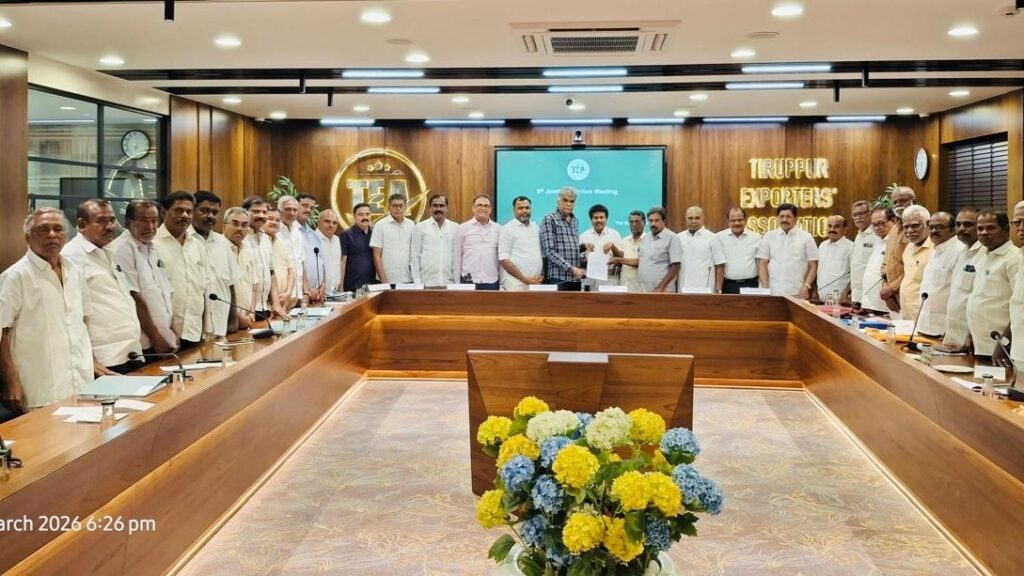
Subsequently, a new round of wage negotiations commenced on 04.11.2025 with the formation of a joint committee. This committee comprised representatives from six major employer associations, including the Tiruppur Exporters Association, and nine recognized trade unions.
The negotiations progressed through nine rounds.
Complex discussions, diverse perspectives — yet a shared goal of progress.
Timely Intervention and Collective Resolution
At a critical juncture when discussions were becoming prolonged, Padma Shri Dr. A. Sakthivel, Founder President of the Tiruppur Exporters Association, personally intervened.
Taking into account the industrial climate, worker welfare, future growth, and emerging challenges, he facilitated an amicable settlement.
Experience and vision turned a moment of uncertainty into a path of agreement.
Bridging Perspectives Through Experience
A key figure who acted as a bridge between both sides was senior member and industry veteran Mr. Prem Duraisamy.
His experience and balanced perspective, developed through participation in all previous negotiations, served as a valuable learning experience for many of us.
Bridging differences requires not just knowledge, but understanding.
Leadership That Builds Trust
Under the leadership of Mr. K.M. Subramanian, not only as President of the Tiruppur Exporters Association but also in his broader social and organizational roles, the negotiations reached an unprecedented level of smoothness.
His leadership exemplifies the wisdom of Thiruvalluvar’s words:
“இதனால் இவன் முடிப்பான் என்றாய்ந்து அதனை அவன் கண் விடல்”
(Entrust responsibility to the one capable of delivering results.)
Both trade union and employer representatives acknowledged that in the 34-year history, negotiations had never progressed with such ease as under his leadership.
True leadership is measured by trust, not authority.
A Meaningful and Enriching Experience
The nine rounds of discussions were conducted in a highly constructive and healthy manner, covering multiple dimensions including global industry trends, socio-economic conditions, industrial challenges, and worker welfare.
Personally, I consider this an enriching experience.
Every dialogue became a learning — every perspective added value.
Gratitude for Collective Contribution
On behalf of the Tiruppur Exporters Association, I extend my sincere appreciation to General Secretary Mr. N. Thirukumaran, Treasurer Mr. R. Gopalakrishnan, Chairman of the Labour Welfare Sub-Committee Mr. N. Krishnamoorthy, and all employer and trade union representatives who contributed their valuable insights throughout the discussions.
I am also personally gratified to have made my own modest contribution to this process.
Even the smallest contribution becomes meaningful in a collective journey.
The Real Outcome
Ultimately, in the 34-year history of these negotiations, the true winner is neither the employers nor the trade unions — it is the Tiruppur knitwear industry itself.
+When collaboration succeeds, everyone wins — but the industry wins the most*.
The Way Forward
Whenever the industry faces challenges, it is the collective strength of both employer associations and trade unions, standing shoulder to shoulder, that ensures its continued growth and sustainability.
Tiruppur’s strength lies not just in production, but in partnership.