


By Nithin Kumar
From a modest dyeing operation established for backward integration of their garmenting operations, PI Cottex Pvt Ltd has grown into a vertically integrated knitted fabric manufacturer with a strong focus on quality, process control and export-oriented markets. For Jasdeep Singh, Managing Director, PI Cottex Pvt Ltd, the company’s long association with A.T.E. has played a decisive role in this evolution — not merely through a long-term partnership approach starting from machinery supply, but through technology selection too installation support, service and process guidance.

Building an Integrated Fabric Platform
In the textile industry, growth is rarely a function of capacity alone. It is shaped by the ability to understand changing customer expectations, invest in the right processes, build reliability on the shopfloor and deliver consistent quality across product categories. PI Cottex Pvt Ltd, based in Ludhiana, reflects this broad competency act.
The company’s journey began in 2007, when Jasdeep Singh had just completed his graduation and joined the family’s textile business. At the time, his father was engaged in garment exports, and the decision to set up a dyeing plant was driven by the need for backward integration. The first operation was modest — a tubular fabric dyeing set-up with a capacity of around 2.5 tonnes per day, equipped with basic Indian dyeing machines.
That first investment gave the company process knowledge and control over its own requirements. Over time, PI Cottex moved beyond internal consumption building a broader manufacturing base. The major shift came after the Covid period, when the company began investing in knitting and moved towards fabric selling. This opened new markets beyond its earlier Ludhiana-focused job-work business and positioned PI Cottex as a more integrated fabric manufacturer.
Today, PI Cottex operates across knitting, dyeing, printing and finishing, with a focus on knitted fabrics for T-shirts, hoodies, lowers, innerwear and stretch applications. According to Singh, the company currently produces approximately 20–22 tonnes of knitted fabrics per day, or around 600 tonnes per month. Its product direction includes cotton and blended fabrics as well as polyester-spandex and nylon-spandex fabrics, serving an increasingly export-oriented customer base.
For PI Cottex, integration has not been pursued simply for scale. It has been a way to gain better control over quality, consistency, development speed and customer response — all of which are becoming increasingly important in the knitted fabric segment.
Responding to a More Demanding Market
The market for knitted fabrics has changed significantly. Customers are no longer looking only for competitive pricing. They expect consistent shade, controlled GSM, better fastness, dimensional stability, improved shrinkage performance, reliable delivery and the ability to develop new fabrics quickly.
These expectations are even more demanding in polyester, nylon and spandex-based fabrics, where processing discipline has a direct bearing on fabric performance. Activewear, athleisure, innerwear and stretch fabric applications require careful control at every stage — from preparation and dyeing to heat setting and finishing.
Singh is clear about the operational challenges that shaped PI Cottex’s investment decisions. Earlier, the company faced concerns related to fastness, shrinkage and GSM variation. The answer was to invest in better technology, imported machinery and skilled manpower capable of handling each process with increased consistency.
“We are trying to achieve the best quality in knitted fabrics,” says Singh. “Earlier, we faced issues such as fastness, shrinkage and GSM variation. With the international set-up, these areas are now much better controlled.”
This focus on quality has become central to PI Cottex’s growth. The company’s manufacturing approach is built around stronger process control, better infrastructure and an ability to serve customers who require both regular production and new fabric development.
The A.T.E. Association
PI Cottex’s association with A.T.E. began around 2013, when the company purchased its first dyeing machines through A.T.E. What began as a machinery transaction gradually developed into a long-term technology relationship.
For Singh, the reason was straightforward: A.T.E. brought not only machinery, but also guidance.
“They guided us on which dyeing machines we should use and which finishing machines we should use,” he says. “They have a strong range of international principals. As per our requirement, we would give them the problem, and they would give us the solution.”
This advisory role became increasingly important as PI Cottex expanded from dyeing into a more integrated fabric operation. The company needed support not only in buying machines, but in identifying the right technologies for specific process needs. According to Singh, A.T.E. supported PI Cottex in areas such as factory layout, process planning, machinery selection and technical guidance across knitting, dyeing, printing and finishing.
This is where the relationship moves beyond the conventional supplier-customer model. For a textile manufacturer planning modernisation, machinery selection is rarely a standalone decision. The machine must suit the product mix, process route, utility availability, quality requirements, manpower capability and future expansion plans. A.T.E.’s strength in PI Cottex’s case was its ability to connect these requirements and recommend technologies accordingly.
Machinery as Part of a Larger Process Strategy
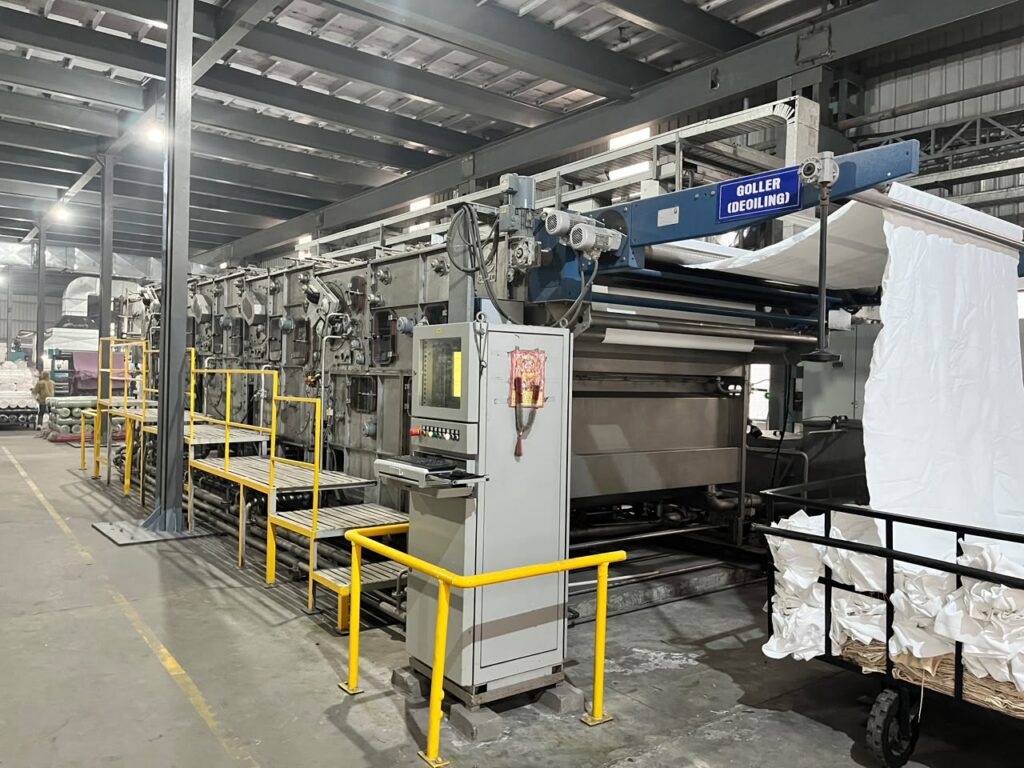
Over the years, PI Cottex has invested in a range of technologies through A.T.E., including Fong’s dyeing machines, Monfongs stenters, Corino slitting lines and Goller spun oil washing/de-oiling technology. Each of these investments supports a specific requirement in knitted fabric processing.
The dyeing machines have helped PI Cottex address one of the most important aspects of wet processing: water consumption. Singh notes that the Fong’s dyeing machines support low liquor ratio processing, helping the company reduce water usage and lower the load on effluent treatment.
“In dyeing, the major factor is water consumption,” he explains. “With the Fong’s dyeing machines, we are achieving a low liquor ratio. This helps reduce water use, reduces the load on the ETP and also saves utility cost.”
For a processing unit, this has a direct impact on both cost and sustainability. Lower water consumption reduces effluent load, lowers chemical and energy pressure and supports more efficient operations. Singh sums it up simply: “Better technology gives better output.”
The Monfongs stenters support finishing, drying and heat setting — processes that are critical for controlling fabric width, GSM, dimensional stability and final fabric appearance. In knitted fabrics, especially those involving stretch blends, finishing performance has a direct impact on customer acceptance. Consistent heat setting and finishing help ensure that the fabric behaves reliably during garmenting and end use.
The Corino slitting lines support fabric handling and preparation, particularly where tubular knitted fabric needs to be opened and processed in open width. Accurate slitting and controlled handling are important for reducing distortion and ensuring smooth subsequent processing.
Together, these technologies have helped PI Cottex build a stronger process route — from preparation and dyeing to finishing and dispatch.
Why De-Oiling Matters in Synthetic Stretch Fabrics
One of the most significant investments for PI Cottex has been the Goller spun oil washing/de-oiling range. The importance of this technology lies in the company’s growing focus on synthetic and stretch fabrics.
For years, many high-performance synthetic and stretch fabric categories — particularly those used in gymwear, athleisure and activewear — were heavily associated with imports from countries such as China, Korea and Taiwan. For Indian processors to compete in these segments, preparation becomes critical.
Polyester, nylon and spandex yarns often carry processing oils. If these oils are not removed before heat setting, they can get fixed onto the fibres, making them difficult to remove later and affecting dyeing, finishing, fabric feel and appearance. Singh identifies this as a basic but crucial step in synthetic fabric processing.
“The first core process is to remove the oil, then do the heat setting, followed by the other processes,” he says. “Otherwise, if the fabric is directly heat set, the oil gets fixed on the fibres and cannot be removed properly later.”
The Goller de-oiling technology has therefore given PI Cottex a stronger foundation for processing synthetic stretch fabrics. It has enabled the company to approach product categories that require cleaner preparation and better process control.
“The Goller de-oiling machine has opened up many brands for us,” Singh says.
That statement is important because it connects machinery investment directly to market access. For PI Cottex, the machine is not simply an equipment addition; it is a business enabler that has helped the company serve more demanding fabric categories and customer requirements.
Service as the Real Test of Partnership
In textile machinery, the real test of a supplier often begins after installation. Machinery performance depends not only on equipment quality but also on installation, commissioning, operator support, troubleshooting, spare availability and the responsiveness of the service team.
For PI Cottex, this has been one of the strongest reasons for continuing its relationship with A.T.E.
“Our major reason to be associated with A.T.E. is their after-sales service,” says Singh. “If any problem occurs, their service team is always ready to support us.”
He adds that A.T.E.’s support has not been limited to the technical teams of its international principals. A.T.E. also has its own service and technical team, which has helped build confidence at the plant level.
The growth of the relationship is reflected in the share of A.T.E.-supplied machinery at PI Cottex. Singh says the company began with one or two dyeing machines from A.T.E., and today a significant portion of the plant is equipped with A.T.E.-supplied technologies.
This is not merely a matter of repeat buying. It points to trust built through continuity of service, responsiveness and practical problem-solving. For manufacturers, especially in processing, downtime, quality variation or delayed support can directly affect production schedules and customer commitments. A dependable service partner therefore becomes as important as the machine itself.
Learning from A.T.E.’s Customer Approach
One of the more interesting aspects of the PI Cottex–A.T.E. relationship is the way it has influenced PI Cottex’s own customer service philosophy.
Singh says the company has adopted a similar approach with its fabric customers. After supplying fabric, PI Cottex continues to support customers with new developments, sampling and quick responses to specific requirements. Every fabric is checked and inspected before dispatch, and the company’s focus is on reducing complaints while remaining available for development-led support.
“The same after-sales service approach that A.T.E. follows, we are trying to follow with our customers,” he says. “If they have a new query or development in mind, we make samples and support them.”
This approach is particularly relevant in today’s fabric market, where buyers expect speed, flexibility and development capability. A fabric supplier is no longer judged only by production capacity; it is judged by how quickly it can respond to ideas, correct issues and support new programmes.
Sustainability Through Better Process Control
For PI Cottex, sustainability is being approached through practical manufacturing measures. The company is connected to a Common Effluent Treatment Plant, and Singh notes that it uses agro-waste such as rice husk as part of its effort to control air pollution.
The machinery investments also contribute to more responsible processing. Low liquor ratio dyeing helps reduce water consumption and effluent load. De-oiling before heat setting supports cleaner processing of synthetic and stretch fabrics. Efficient finishing and controlled fabric handling reduce process instability and improve output reliability.
In a sector where water, energy and effluent management are increasingly important, these improvements have both operational and environmental significance. They help the company improve efficiency while preparing for tighter resource and compliance requirements.
Preparing for the Next Phase
PI Cottex’s next phase of growth is likely to be shaped by automation, resource optimisation and further integration. Singh says the company is now focusing on automating wherever possible within the factory since the colour kitchen was house automated. He also points to water availability and regulatory norms as important considerations in future expansion.
The company is exploring ways to increase production within existing resource constraints. According to Singh, A.T.E. continues to guide PI Cottex on how to control water consumption and improve output within available limits. Looking ahead, the company may consider doubling production and eventually exploring backward integration into spinning.
These plans remain dependent on execution, water availability, regulatory approvals and market conditions, but they indicate the direction in which PI Cottex is thinking: more automation, deeper integration, better process control and stronger manufacturing capability.
A Model for Technology-Led Manufacturing
PI Cottex’s story holds a relevant message for textile manufacturers across India. Modernisation is not simply about buying imported machines. It is about aligning technology with product strategy, customer expectations, resource efficiency and long-term competitiveness.
For PI Cottex, the decision to work with A.T.E. has helped the company make this transition with greater confidence. A.T.E.’s role has extended from machine supply to technology recommendation, plant-level support, installation, service and continuous guidance. This has allowed PI Cottex to move from a dyeing-led operation to a more integrated fabric manufacturing platform.
The larger lesson is clear. In today’s textile industry, the right machinery partner can help manufacturers move from routine production to more consistent, efficient and future-ready operations. For companies serving demanding fabric markets, this can directly influence quality, customer trust and the ability to develop new business.
Singh captures the essence of this relationship when he says, “Long-term relations can be successful only if both sides work parallelly and guide each other.”
That is the foundation of PI Cottex’s partnership with A.T.E. It is not a story of machines alone. It is a story of technology decisions made with purpose, service delivered with consistency, and a textile manufacturer preparing itself for the next phase of growth.