


The 2026 anniversary edition connected circular materials, performance fabrics and AI with international sourcing, showing how Taiwan’s textile expertise can serve the next generation of products.
By Nithin Kumar
TITAS 2026 made the connections between material development, garment design and factory performance easier to see. Its 30th edition paired recovered fibres and functional fabrics with finished concept garments and digital production tools, giving buyers concrete examples of how Taiwan’s textile capabilities can support their next product.
Held from 6 to 8 October at Taipei Nangang Exhibition Center, Hall 1, the 30th Taipei Innovative Textile Application Show brought together 410 exhibitors from 12 countries across 977 booths. Organiser Taiwan Textile Federation (TTF) reported approximately 30,405 buyer visits over the three days and estimated future business opportunities at US$60 million.
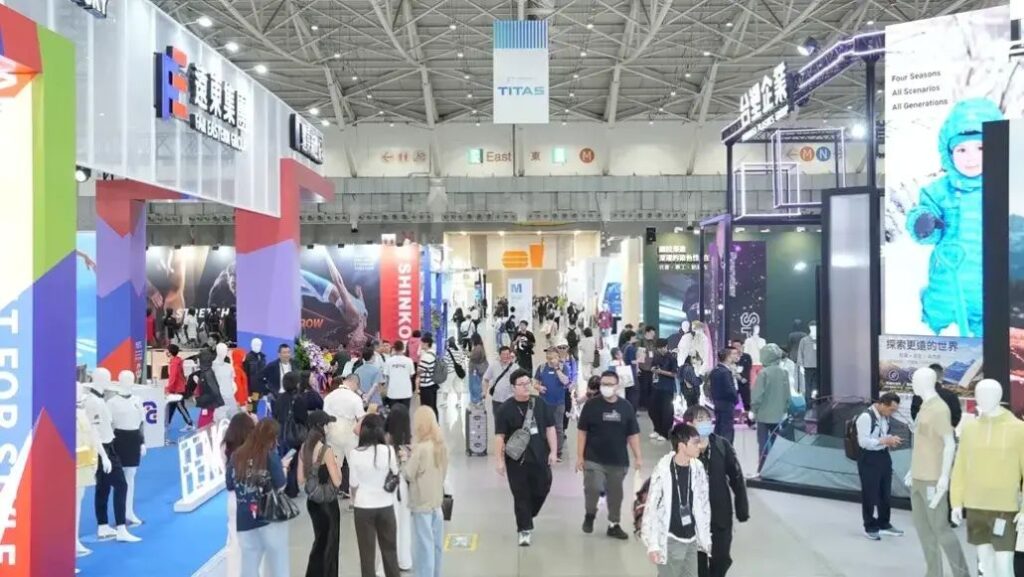
Since its debut in 1997, TITAS has given Taiwanese suppliers a shared platform for reaching international brands. Its 30th edition put that role into perspective: functional fabric development is increasingly connected with circular design and digital production, broadening the scope of the sourcing conversation.
The sourcing programme connected more than 70 international brands from 16 markets with Taiwanese exhibitors in over 900 procurement meetings. Visiting delegations also came from India, Japan, South Korea, Vietnam and Thailand.
The new Italian pavilion, organised by the Italian Trade Agency with ACIMIT, brought 11 machinery companies, including FADIS, Color Service, Corino and Danitech. Korean participation included Hyosung, while Japan’s returning pavilion drew on the Ishikawa and Fukui fibre associations. Their presence added manufacturing expertise to Taiwan’s material offering.
Circularity begins with material choices
The exhibition’s circular-material offering extended beyond recycled PET bottles to textile waste and discarded fishing nets. Equally significant was the attention to design: recovering a finished garment depends partly on decisions about its fibres, stretch components and construction long before it reaches a recycling plant.
Far Eastern New Century (FENC) connected performance textiles with that design argument. Its TITAS portfolio included TopCool® Petal moisture-management fibre, which the company links to 2026 World Cup jerseys, alongside textile-to-textile recycling developments. All-polyester synthetic leather and footwear using recycled thermoplastic polyester elastomer illustrated its efforts to simplify material combinations and find new applications for recovered polyester.
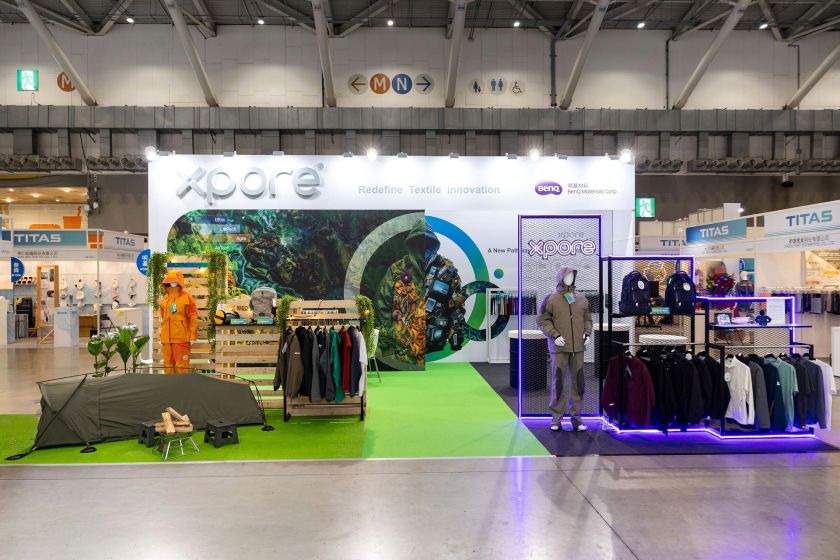
FENC’s e2cycle collaboration with BenQ Materials added another recovery route, using high-purity optical PET waste from display panels to make textile materials. It showed how a specialised waste stream could supply applications beyond conventional garment and bottle feedstocks.
At the Formosa Plastics Group pavilion, Nan Ya’s Nyudex thermoplastic polyester elastomer yarn addressed the demand for stretch in polyester-based fabrics. It offers an alternative to conventional elastane in suitable applications. Everest Textile’s mono-material stretch developments pursued a related objective. These approaches seek to simplify recovery, although actual recyclability still depends on the complete product and the process available to handle it.
Lealea Group’s Forever Yarn range highlighted fibre recovered from discarded fishing nets. Honmyue Enterprise presented its own circular-fabric directions around textile waste, recovered fishing-net nylon and bio-based materials. The variety was useful for buyers: recycled and renewable inputs offer different development routes, each requiring attention to composition, performance and the intended application.
Performance and AI in production
Functional performance remained central to the show. Eclat Textile’s Airflow presentation focused on engineered knit structures intended to improve air movement between the body, fabric and environment. Its Drylight, Woveknit, Nual and Aerojaq lines combined that emphasis with breathability, quick drying and comfort.
TTF’s closing assessment also identified protective, medical and aerospace applications as areas of development. These markets broaden suppliers’ opportunities while increasing the importance of performance verification and documentation for the intended use.
Artificial intelligence was particularly relevant to quality control. The Printing Technology Research Institute’s showcase combined AI with hyperspectral imaging to assess yarn characteristics and conductive-coating uniformity without destroying samples. OSHIMA’s EagleAi® uses AI-based visual recognition to detect, classify and map fabric defects, creating records that can inform subsequent production decisions.
OSHIMA’s PlySight™, introduced in August 2026, links EagleAi’s defect records with a garment marker and lay plan. Within its Smart Factory Platform, planners can see which pieces and layers may be affected before fabric is spread.
For cutting rooms, that makes inspection data part of the production plan. Teams can evaluate roll arrangements before committing material and consider how recorded defects may affect cut pieces. OSHIMA positions the capability as a way to reduce rejected pieces and re-cutting.
Research organisations broadened the technology programme. The Ministry of Economic Affairs’ Department of Industrial Technology pavilion brought together six institutions, including the Industrial Technology Research Institute and the Taiwan Textile Research Institute. Its showcase comprised more than 40 government-funded developments spanning materials, processes and testing.
The technical agenda complemented the exhibits with sessions on circular fibre applications, European product regulation and digital product passports. SGS’s published on-site programme included ergonomic performance and PFAS-related regulatory solutions. Such topics matter because a promising fabric must also meet the testing, documentation and market requirements attached to its intended use.
Connecting materials with the market
One of the anniversary edition’s most useful additions was Taiwan Textile Select. The new apparel display combined materials and technologies from more than 30 businesses in 13 concept garments. Alongside it, the exhibition’s wider showcase brought together over 500 fabrics, trims and yarns. Interactive tables added a further way for buyers to explore the display.
Showing materials as garments connected technical descriptions with recognisable end uses. For sourcing and design teams, it offered a clearer basis for discussing how fabrics might work in a collection and how material suppliers could contribute to the finished product.
Speaking exclusively to The Textile Magazine at TITAS, TTF President Justin Huang put the commercial priority plainly: “We do whatever our clients ask for,” he said of Taiwanese mills. Their innovations ultimately have to meet brands’ product requirements.
Sampling, qualification and repeat business will determine how much of TITAS 2026’s commercial promise is realised. With the next edition scheduled for 5–7 October 2027, Taiwan’s strongest case to buyers remains the connection between material expertise, product development and manufacturing capability.