


By. K. Gopalakrishnan
From Textile Trolleys to Comprehensive Printing Technologies
For nearly seven decades, Ahmedabad-based Embee Group has remained at the forefront of innovation in textile printing technology. Established in 1956 by Late Shri Babubhai Shah, the company has evolved from a manufacturer of textile trolleys into one of India’s most comprehensive providers of textile printing solutions, serving customers across domestic and international markets.
Over the years, Embee has continuously expanded its capabilities, first through the indigenization of textile machinery components and later by pioneering the development of India’s rotary printing machinery. Today, the company offers an end-to-end portfolio covering the complete textile rotary printing process, including screen preparation, colour preparation, sample printing systems, rotary printing machines, and a wide range of post-printing accessories.
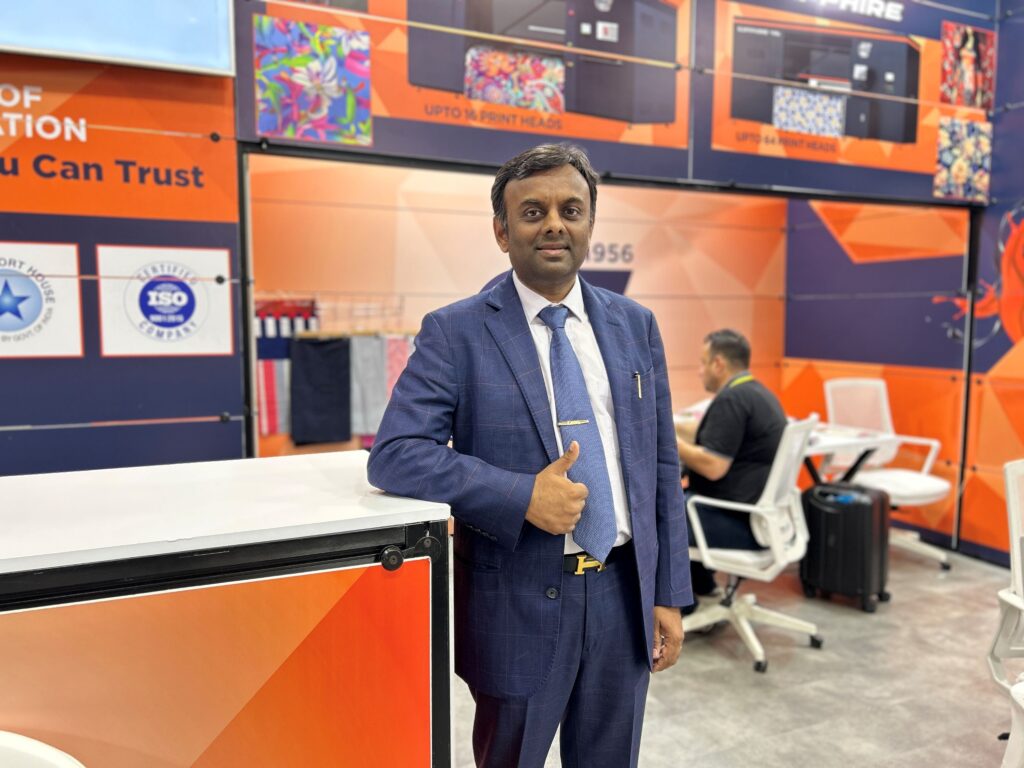
“Our focus has always remained on providing total printing solutions,” says Mr. Harsh Shah, Managing Director, Embee Group.
This customer-centric philosophy has enabled the company to establish a strong presence across major textile clusters in India, including Ahmedabad, Surat, Mumbai, Delhi-NCR, Erode, and Tirupur, while building a robust export business spanning more than 25 countries. Exports today contribute over 40% of the company’s revenues, with markets extending across Asia, the Middle East, Africa, Turkey, Uzbekistan, and Latin America.
Innovation as a Core Business Philosophy
Innovation has been central to Embee’s growth story and continues to define its competitive advantage. The company has consistently focused on developing new technologies and solutions that enhance efficiency, improve sustainability, and address the evolving needs of textile printers.
One of Embee’s most notable achievements has been the development of the world’s first laser stripping machine for textile rotary screens—an innovation that transformed a critical stage of the textile printing process. The company is also unique in offering a complete ecosystem of textile printing technologies, ranging from screen preparation systems and colour preparation equipment to rotary printing machines, laboratory printing systems, consumables, and accessory equipment.
“Being into machinery engineering, innovation and technology is our lifeline,” explains Mr. Shah.
The company continues to invest in automation across its product portfolio and is actively exploring the application of artificial intelligence in textile manufacturing. While AI is already being utilized internally for communication and research functions, Embee sees significant future potential for intelligent solutions within textile printing processes.
Recognizing the growing importance of digital printing, the company has also entered this segment with the development of India’s first Direct Laser Engraver and customized digital printing solutions designed to address niche and high-precision printing applications.
Sustainability Built into Every Solution
For Embee, sustainability is not an isolated initiative but a fundamental design principle embedded within every product and process.
Mr. Shah believes that the future of textiles is intrinsically linked to sustainable manufacturing practices. This belief has driven the development of technologies that help textile processors significantly reduce their environmental footprint while improving operational efficiency.
The company’s pioneering laser stripping technology has eliminated the need for chemical stripping and largely replaced water-intensive stripping processes, offering substantial savings in both resources and operating costs.
Similarly, Embee’s colour preparation systems are designed to minimize wastage and spillage of printing pastes, while its rotary printing machines incorporate recycled and filtered water systems to reduce fresh water consumption. The company’s energy-efficient dryer technology further contributes to sustainability by lowering energy usage during production.
Several of Embee’s washing systems, including screen and squeegee washing equipment, are capable of utilizing recycled water, reducing water consumption by up to 90 percent. The company also developed a caustic recovery system more than a decade ago, helping textile processors reduce chemical consumption and lower the load on effluent treatment plants.
“Today every product that Embee designs and develops has a sustainability angle inbuilt in it,” notes Mr. Shah.
Navigating Industry Challenges and Emerging Opportunities
Like much of the global textile industry, Embee operates in an environment shaped by economic uncertainty, geopolitical developments, fluctuating raw material costs, and shifting trade dynamics.
According to Mr. Shah, the biggest challenge facing the industry today is uncertainty. Issues ranging from tariff disputes and geopolitical conflicts to inflationary pressures and currency volatility have affected textile businesses worldwide.
Despite these challenges, he remains optimistic about the long-term prospects for India’s textile industry. The government’s efforts to strengthen international trade relationships through Free Trade Agreements are expected to create new opportunities for textile exporters while simultaneously benefiting machinery manufacturers.
“The series of trade agreements being signed by the government is commendable and will create long-term opportunities for the Indian textile industry,” he observes.
The company also believes that India’s diversified textile value chain and growing domestic market provide a strong foundation for sustained growth.
Looking Ahead: Innovation, Exports and Made in Bharat
As Embee charts its next phase of growth, the company remains firmly focused on solving customer challenges through innovation and technology. The growing adoption of digital printing, increasing demand for sustainable production solutions, and expanding export opportunities are expected to drive future growth.
Mr. Shah believes that both rotary printing and digital printing will continue to coexist, each serving distinct market requirements. Embee’s strategy is therefore centered on offering highly customized solutions that address specific customer needs while maintaining its leadership in conventional printing technologies.
Looking at the broader industry, he sees tremendous potential for India’s textile sector, supported by a strong manufacturing base, a large domestic market, and increasing global competitiveness.
However, he emphasizes the need for greater investment in research and development and a stronger export-oriented mindset.
“We need to invest more in research and development to solve problems and not just do what the guy next door is doing,” he says. “Lastly, we Indians need to be proud of saying our products are Made in Bharat.”
With a legacy spanning nearly 70 years, a culture of continuous innovation, and a steadfast commitment to sustainability, Embee Group remains well positioned to contribute to the future evolution of textile printing technology—both in India and across global markets.