


By K. Gopalakrishnan
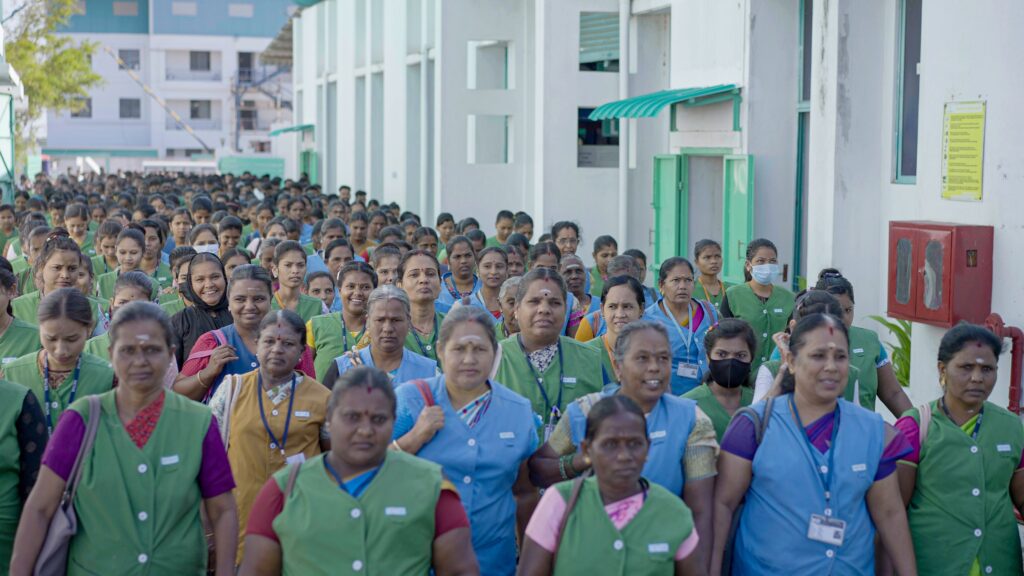
Tirupur’s garment manufacturing cluster thrives on the strength of its workforce, a significant proportion of whom are women. Yet, despite their vital contribution to the industry, garment manufacturers continue to grapple with two longstanding HR challenges: high employee attrition and the limited representation of women in leadership positions.
Addressing these challenges calls for innovative HR practices that go beyond recruitment and routine workforce management, focusing instead on employee retention, well-being, skill development and transparent career progression. In an interesting development, two practical solutions to these persistent HR challenges have been identified by Ms. Akshera Avanti Dineshkumar, a Grade XII student at The International School (TISB), Bengaluru, through her research. Akshera explored both challenges as part of her research at Victus Dyeings, a Tirupur-based company owned by her family. Her father, Dineshkumar Loganathan and her mother, Kavitha Dinesh have been a huge support. Her research led to the development of a Financial and People Well-being Framework to improve workforce attraction and retention, and the People Value Matrix, designed to create a more transparent and objective pathway for women workers to progress into leadership roles. Both initiatives seek to address persistent industry concerns through structured, people-centric approaches.

Financial Literacy & People Well-being
Rather than viewing employee attrition as an isolated HR problem, Akshera examined the connections between recruitment, earnings, employee benefits and workers’ understanding of their overall employment package. Her analysis indicated that workers could receive salaries, bonuses, overtime payments, Provident Fund (PF), Employees’ State Insurance (ESI), gratuity and government-linked incentives, including NATS-related benefits, without necessarily recognizing the cumulative value of these earnings and benefits.
The issue, therefore, was not merely the compensation offered, but also how effectively its value was communicated to workers. Akshera also recognized that employee well-being extends beyond monetary compensation. Workplace safety, empowerment, skill development and opportunities for career advancement all contribute to an employee’s experience and long-term association. This understanding led her to develop a Financial Literacy and Well-being Framework built around two pillars: financial literacy & people well-being.
Framework That Communicates Value
The framework uses simple visuals, practical rupee-based examples and easy-to-understand explanations to help workers appreciate the full range of benefits available to them. The financial component covers salary, bonus, earned leave (EL), NATS/ELI-related benefits, gratuity, PF, ESI, paid maternity leave, attendance bonus, performance-linked incentives, referral incentives, retention bonuses and royalty rewards, as applicable. The people well-being component highlights the non-financial aspects of employment, including a safe workplace, a respectful work culture, skill development, women’s empowerment, career growth, educational support, crèche facilities, work-life balance and a healthy working environment. By presenting these elements together, the framework seeks to give workers a more comprehensive understanding of what they gain through their employment.
As the underlying principle of the framework puts it, income tells a worker what she earns, while value helps her understand why it matters. The objective is to make the overall employment proposition clearer and more meaningful.
From Concept to Implementation
Akshera subsequently digitized the framework and introduced it at the recruitment stage, enabling mobilization teams to explain the company’s employment proposition to prospective workers. The approach has reportedly yielded encouraging results. Workers have gained a better understanding of their earning potential and workplace benefits, while recruitment teams have found it easier to communicate the value of employment through a simple visual tool. The company has also reported improvements in retention, as workers become more aware of the financial and non-financial benefits associated with staying with the organization. Encouraged by the initial response, Akshera shared the framework with neighboring garment units. The initiative is now being implemented across five factories in the Tirupur cluster: Victus Apparel Pvt. Ltd., SCM Garments, Balu Exports, Aathava Garments and K.M. Knitwear. The initiative demonstrates how clearer communication of compensation and workplace benefits can become a useful component of a broader workforce retention strategy.
People Value Matrix
Women constitute a substantial proportion of the frontline workforce in India’s garment industry, but their representation often declines at higher levels of the organizational hierarchy. Although women play a vital role in production, relatively few progress into supervisory and managerial positions. This disparity, commonly referred to as the industry’s “pink-collar” challenge, formed the subject of Akshera’s published research paper, “The ‘Pink Collar’ Workforce: Analyzing the Glass Ceiling in Garment Factories in Tamil Nadu, India,” featured in the Seventh Sense Research Group’s International Journal of Humanities and Social Science.
The research examined the factors that restrict women’s progression from shop-floor positions to supervisory and leadership roles. Among the issues identified, the absence of a transparent and standardized career development system emerged as an area that could be addressed through a structured intervention. When career progression depends largely on subjective assessments, capable employees may not always receive recognition for their skills and performance.
Akshera’s proposed solution was to establish clear, measurable criteria for evaluating workers and identifying those ready to take the next step in their careers. This led to the development of the People Value Matrix (PVM), a system-driven tool designed to make skill assessment and the transition from operator to team leader more objective and transparent.
Measuring Skill through Performance
The PVM captures each frontline operator’s daily performance in terms of quality and productivity. The data is recorded online in real time and converted by the system into a Skill Score for each operation performed by the worker. Based on this score, operators are graded and upgraded through four levels: C, B, A and J, with J representing Jumper status. The progression is linked to demonstrated skill and performance rather than length of service or subjective assessments. A new entrant typically begins at Grade C. As the worker demonstrates improvements in quality and productivity across different operations, the system recognizes this progress and facilitates advancement to Grade B, Grade A and, ultimately, Jumper status. The objective is to establish a measurable basis for recognizing competence and identifying workers who are ready to assume greater responsibility.
Enabling the First Step into Leadership
One of the most critical stages in a woman’s career is the transition from frontline operator to team leader. While the garment industry employs large numbers of women on the shop floor, this first step into leadership can be difficult to navigate when promotion criteria are unclear or inconsistently applied. The PVM is designed to address this transition by using Jumper status as the trigger for identifying operators who are ready to be considered for promotion to leader.
The decision is anchored in the worker’s demonstrated skill score, rather than relying solely on subjective observation. In this way, the matrix seeks to establish a clearer and more consistent pathway for capable women workers to enter supervisory roles. By making the criteria visible and performance- based, it also aims to improve transparency in the promotion process. Once an employee becomes a team leader, her career can progress through a defined hierarchy comprising Technician, Junior Executive, Executive, Senior Executive, Assistant Manager, Deputy Manager, Manager, Senior Manager, Assistant General Manager, Deputy General Manager and General Manager.
Progression through these higher positions is governed by the organization’s performance appraisal and succession planning systems, rather than the PVM’s daily skill-scoring mechanism. These processes assess factors such as attitude, leadership capability, annual performance and readiness to take on greater responsibilities. The PVM’s role is therefore focused on a specific but significant stage of career development: creating a more objective basis for the transition from operator to team leader. Subsequent advancement depends on the employee’s continuing performance, leadership potential and suitability for higher responsibilities.
By linking this crucial first promotion to measurable indicators of quality and productivity, the PVM seeks to reduce subjectivity and give skilled women workers a more transparent opportunity to enter the leadership pipeline.