


By Nithin Kumar
At Techtextil 2026, Akhil Dhoot, Executive Director, Montex, explained how the company is using quality, delivery discipline, coating, lamination and customer-led development to strengthen its position in fiberglass-based technical textiles.
In technical textiles, trust is not built through claims. It is built through repeated consistency. Customers return when a supplier can deliver the same quality every time, meet committed timelines and respond to application-specific requirements with technical confidence.

For Montex, this has become the centre of its proposition.
At Techtextil 2026, Akhil Dhoot, Executive Director, Montex, described the company’s message with refreshing directness. Montex wants customers to associate the brand with quality, reliability and delivery discipline – especially in demanding international markets where performance expectations are high and consistency is non-negotiable.
“What we are trying to tell visitors is that they can rely on Montex for quality and timely delivery,” says Dhoot. “European markets are very concerned about product quality. Once your product qualifies, they want the same quality every time. We are showcasing trust in Montex – trust in our quality and trust in our delivery timelines.”
That focus is particularly relevant to fiberglass-based technical textiles. These are not decorative fabrics. They are engineered materials used in construction, electrical, industrial, automotive and other demanding applications where dimensional stability, reinforcement, insulation, durability and performance matter.
From Fiberglass Fabrics to a Wider Technical Textile Platform
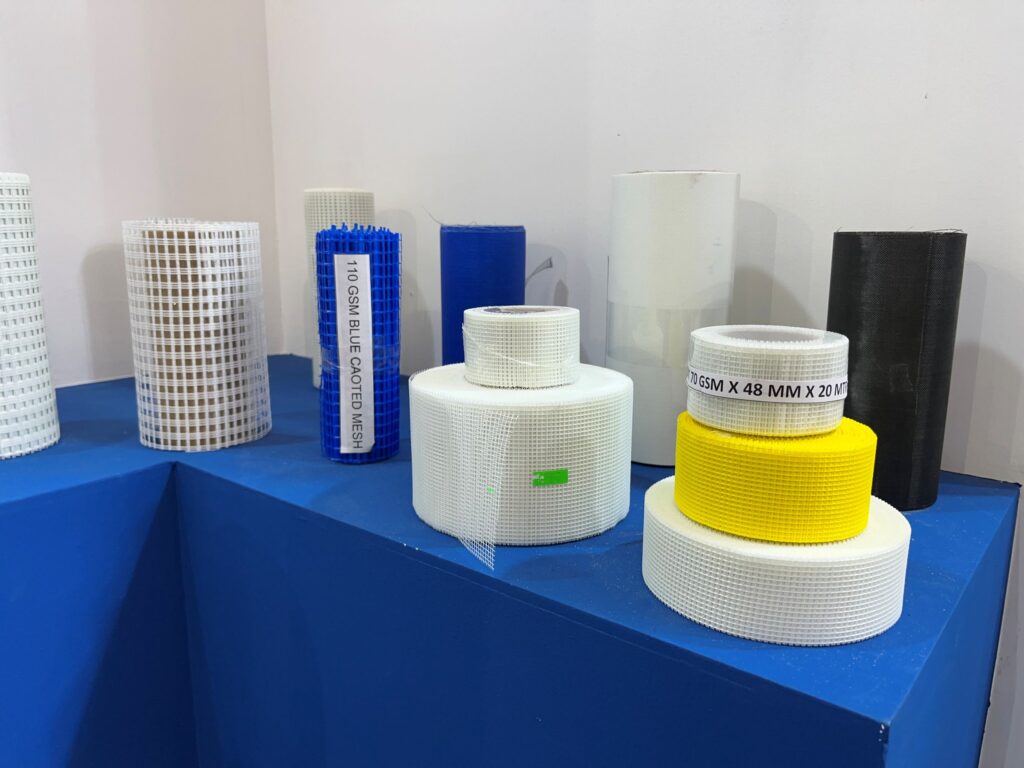
Montex began with fiberglass fabrics and gradually expanded into fiberglass mesh, particularly for the construction industry. This foundation remains important, but the company’s larger ambition is to move beyond standard products and work more closely with customers on application-led development.
“We started with fiberglass fabrics and then evolved into fiberglass mesh for construction,” Dhoot explains. “Where we want to be is continuously working with the industry to innovate newer products. We want to work with our customers to develop products that suit their needs and not remain fixed on one particular quality or product. We are flexible and willing to change.”
This flexibility gives Montex a stronger technical textile identity. In a market where customers increasingly seek customised materials, the ability to adapt a base product to a specific requirement becomes a major advantage. A fiberglass fabric for electrical insulation is not the same as a mesh for construction reinforcement. A coated fabric for heat resistance is not the same as a laminated structure for another industrial use. Each application demands a different understanding of material behaviour.
Montex’s strength lies in using its fiberglass expertise as a platform for wider development. The company is not trying to be everything to everyone. Instead, it is building depth in a specialised segment and using that specialisation to serve varied technical applications.
Coating and Lamination as the Differentiator
One of the most important aspects of Montex’s value proposition is coating and lamination. These capabilities allow the company to move from base fabric supply to customised technical textile solutions.
“Coating and lamination are the value addition we do for our customers,” says Dhoot. “It is the customisation we provide. Once you have a set quality with a customer, they stay with you, because it becomes difficult for competition to replicate the same thing. That is where we want to focus – more coating, more lamination and more customisation.”
This is a strong strategic point. In technical textiles, real value is often created after the base textile is manufactured. Coatings and laminations can provide specific properties such as water resistance, fire resistance, alkali resistance, UV stability, thermal protection, abrasion resistance or improved structural performance. These treatments can transform a standard substrate into a product designed for a defined end use.
For customers, this means they are not only buying a fabric. They are buying a performance solution. For Montex, it creates a stronger relationship with customers because product development becomes more collaborative and less easily substitutable.
This is especially important in international markets. Once a coated or laminated product is qualified for a customer’s application, consistency becomes critical. Any variation in coating weight, adhesion, flexibility, strength or surface behaviour can affect performance. Montex’s emphasis on repeatability and delivery reliability is therefore directly linked to customer confidence.
Construction Remains Strong, Electrical Applications Are Emerging
Among Montex’s current segments, fiberglass mesh continues to be a strong and steady business. The product is widely used in construction-related applications where reinforcement, stability and durability are required.
“Fiberglass mesh is a very standard product and demand is increasing,” Dhoot says. “It is used in construction, and that segment is doing well. On the fabric side also, we are seeing good momentum.”
The fabric side is particularly interesting because new applications are emerging in electrical and electronics-related areas, including PCB boards. Glass fabrics are valued in such applications because of their dimensional stability, thermal performance and electrical insulation properties. As electronics, electrical systems and advanced manufacturing continue to evolve, such materials can gain greater relevance.
Dhoot points to this as an area of opportunity. “There are new applications coming up in PCB boards and related areas,” he notes. “That is catching up, especially in European and US markets, and we hope the momentum continues.”
This mix of established and emerging demand gives Montex a balanced platform. Construction mesh provides a strong volume base, while coated, laminated and higher-performance fabric applications can help the company build a more premium technical textile profile.
Why Physical Trade Shows Still Matter
Dhoot also makes a compelling case for the continued importance of physical exhibitions like Techtextil. In an increasingly digital business environment, technical textiles still require touch, inspection and face-to-face trust.
“It is a chance for us to meet customers and put a face in front of the name,” he says. “Customers can touch the products, feel the products and see the full range of the catalogue. That cannot be fully done in an online meeting.”
For products such as fiberglass mesh, coated fabrics and laminated textiles, this physical interaction is critical. Customers need to assess hand feel, stiffness, surface finish, coating quality, flexibility and overall product construction. These are details that are difficult to communicate through photographs, emails or video calls.
Trade shows also help companies learn from adjacent industries. Dhoot notes that meeting exhibitors and visitors from different sectors offers insight into how others manage operations and respond to market challenges. This kind of cross-industry learning often leads to new thinking and, eventually, new product ideas.
New Products and a Broader Material Horizon
Looking ahead, Montex is adding new products while remaining focused on its fiberglass strength. Dhoot highlights fiberglass electrical tapes as a recent development, with relevance in cable industries, aeronautics and other demanding applications.
The company is also open to exploring other yarns in the future, although fiberglass remains its current priority.
“We are trying to bring in new products,” says Dhoot. “We have recently introduced fiberglass electrical tapes used in cable industries and aeronautics. We may also try to move slightly away from fiberglass and use different yarns for our products. But right now, we are focused on fiberglass and trying to become a leader in this segment.”
That ambition is clear and credible. Montex is not presenting itself as a broad, unfocused technical textile supplier. It is a specialist working to deepen its leadership in fiberglass while expanding the value it can create through coating, lamination and product customisation.
A Specialist With a Flexible Mindset
Montex’s Techtextil 2026 story is built around a simple but powerful formula: quality, delivery, customisation and trust.
In technical textiles, these fundamentals matter more than ever. Customers need suppliers who can provide consistent products, respond to specific requirements and maintain reliability over time. Montex’s fiberglass base gives it technical depth. Its coating and lamination capabilities give it added value. Its willingness to work with customers gives it flexibility.
The company’s future will depend on how effectively it combines these strengths. Construction mesh will continue to offer a strong foundation. Coated and laminated fabrics can open higher-value opportunities. Electrical tapes, PCB-related fabrics and other emerging applications can help Montex build a more advanced technical textile identity.
At Techtextil 2026, Dhoot’s message was not built on exaggeration. It was built on confidence in fundamentals. Montex wants customers to trust its quality, depend on its delivery and work with it to create products that meet real application needs.
In a market where technical performance and supplier reliability are inseparable, that may be the company’s strongest competitive advantage.