


As the textile and apparel industries look beyond standalone automation, Taiwan-based OSHIMA is building closer connections between fabric inspection, production planning and cutting-room operations. In an exclusive interview at TITAS 2026, CEO Mr. Florian Finke discusses the company’s expanding technological capabilities, opportunities in technical textiles and its growing ambitions for the Indian market.
BY Nithin Kumar H
A fabric defect identified during inspection can still become an expensive production problem if the information never reaches the cutting room. The fabric may be inspected, graded and approved for production, yet the precise location of an imperfection can remain disconnected from the marker and spreading plan. By the time it is discovered on a cut component, the opportunity to address it efficiently may already have passed.
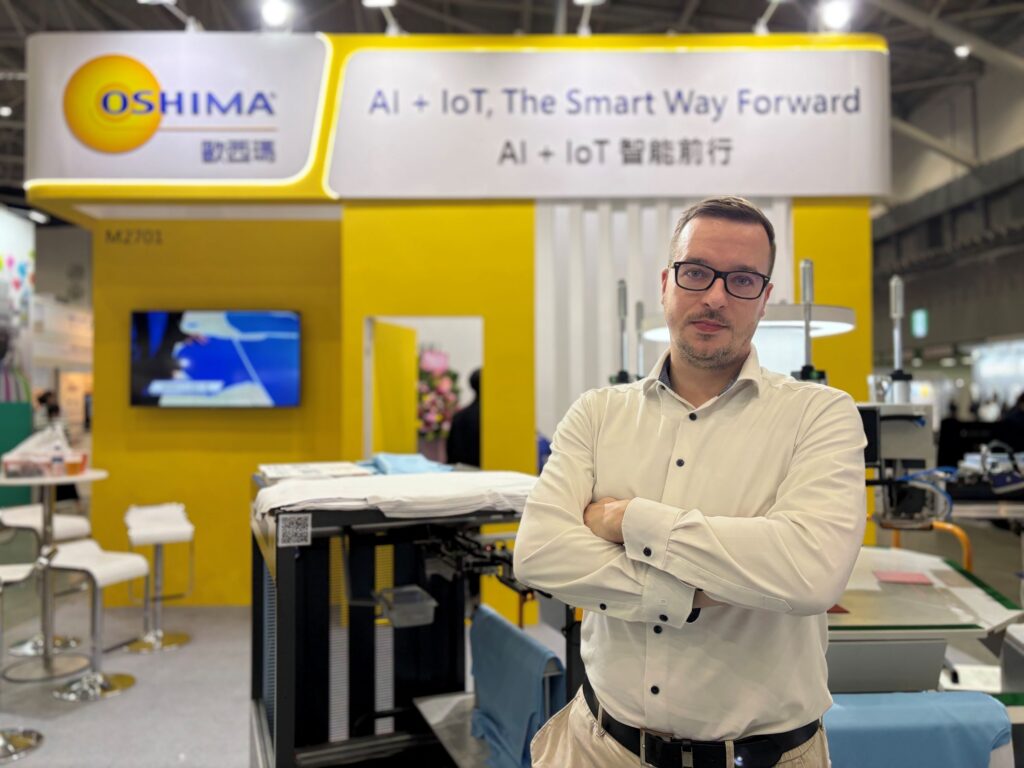
For Mr. Florian Finke, CEO of OSHIMA, this gap between inspection and production represents an important opportunity for the next generation of textile and garment machinery. His vision is not simply to make individual machines faster or more automated, but to enable them to exchange information that manufacturers can use to improve their operations.
Speaking to The Textile Magazine at TITAS 2026 in Taipei, Mr. Finke outlined how OSHIMA is bringing together its expertise in garment machinery, artificial intelligence and software development to create a more connected manufacturing environment.
Founded in Taiwan in 1971, OSHIMA has built its business around equipment for fabric preparation, inspection, spreading, cutting, fusing and garment quality control. Over recent years, the company has expanded its focus to include AI-assisted inspection, digital production monitoring and the integration of manufacturing data. These developments are now becoming an increasingly important part of its technology strategy.
From Fabric Inspection to Intelligent Production Planning
One of OSHIMA’s principal technology highlights at TITAS 2026 was the integration of fabric inspection data with downstream spreading and cutting-room planning.
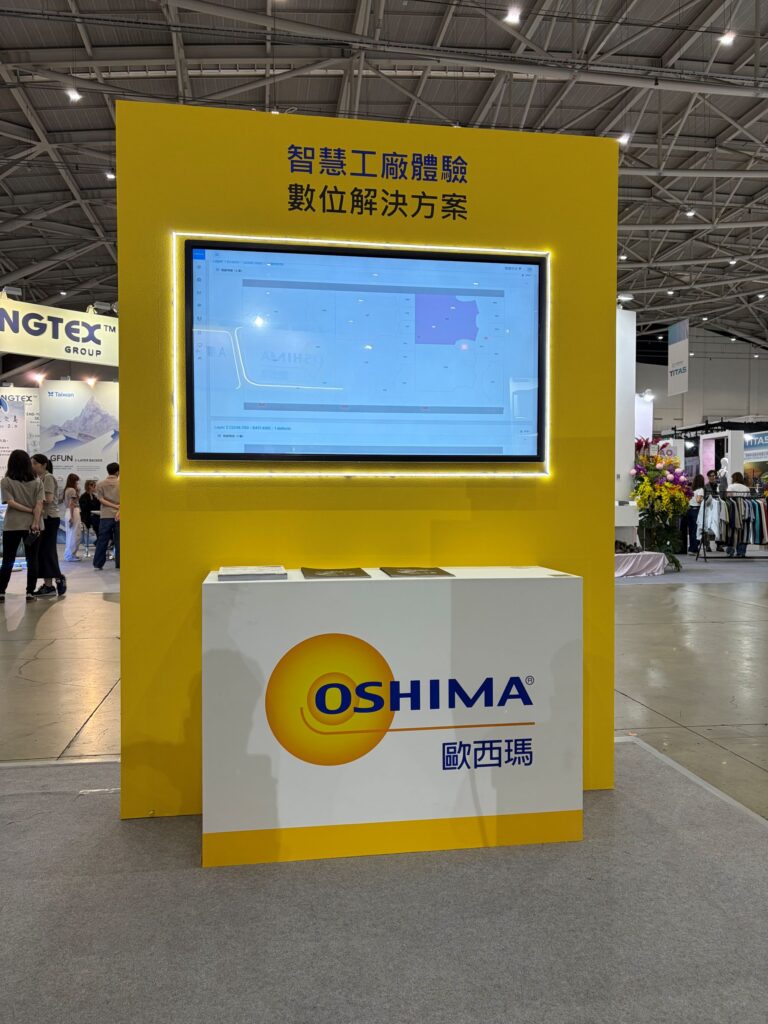
The process begins with EagleAi®, the company’s AI-assisted fabric inspection system, which detects and records fabric defects, including their type, dimensions and location along the length and width of an inspected roll. This information is retained in a digital record associated with the individual fabric roll, providing a more detailed picture of its condition than a conventional defect count or inspection grade.
OSHIMA refers to this roll-level record as a digital defect twin. The information can support incoming material assessment, quality management and traceability, but Mr. Finke sees considerable additional value in applying it directly to production.
That is the purpose of PlySight™, introduced in August 2026 as part of the OSHIMA Smart Factory Platform. The software brings together recorded fabric defects, production marker files, planned ply counts and the selected sequence of fabric rolls to simulate how known defects could affect individual cut components before spreading begins.
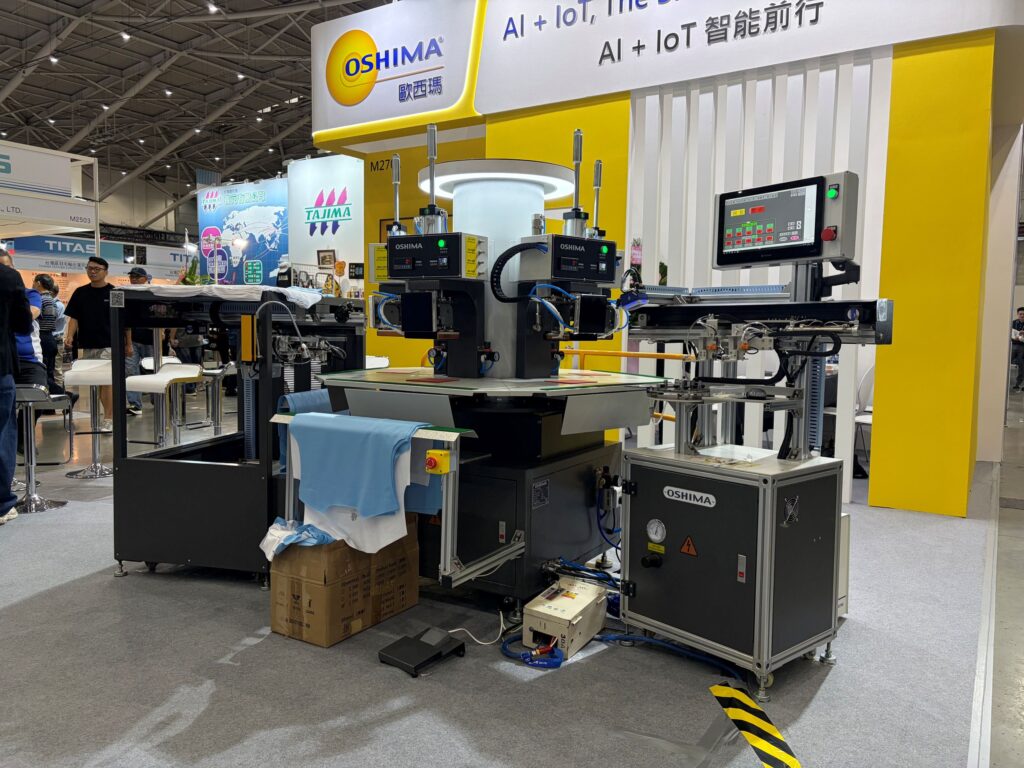
For example, a defect recorded on a particular roll can be mapped to the layer in which it is expected to appear. The simulation then identifies which garment pieces may intersect with that defect, allowing planners to examine the likely consequences of a particular roll allocation.
This changes the practical value of inspection data. A roll containing several defects may still be suitable for a particular marker if those imperfections fall between components or in less critical positions. Conversely, a roll with fewer defects might create greater production difficulties if one falls across an important garment panel.
Manufacturers can compare alternative roll sequences and spreading arrangements before committing fabric to production. The system also identifies potential shortages when the selected rolls cannot provide sufficient material for the planned lay.
Importantly, PlySight does not make the final production decision. The manufacturer must still consider fabric shade, lot consistency, customer specifications and acceptable quality standards. Its contribution is to give the production team better information at an earlier stage, when adjustments are generally easier and less costly to make.
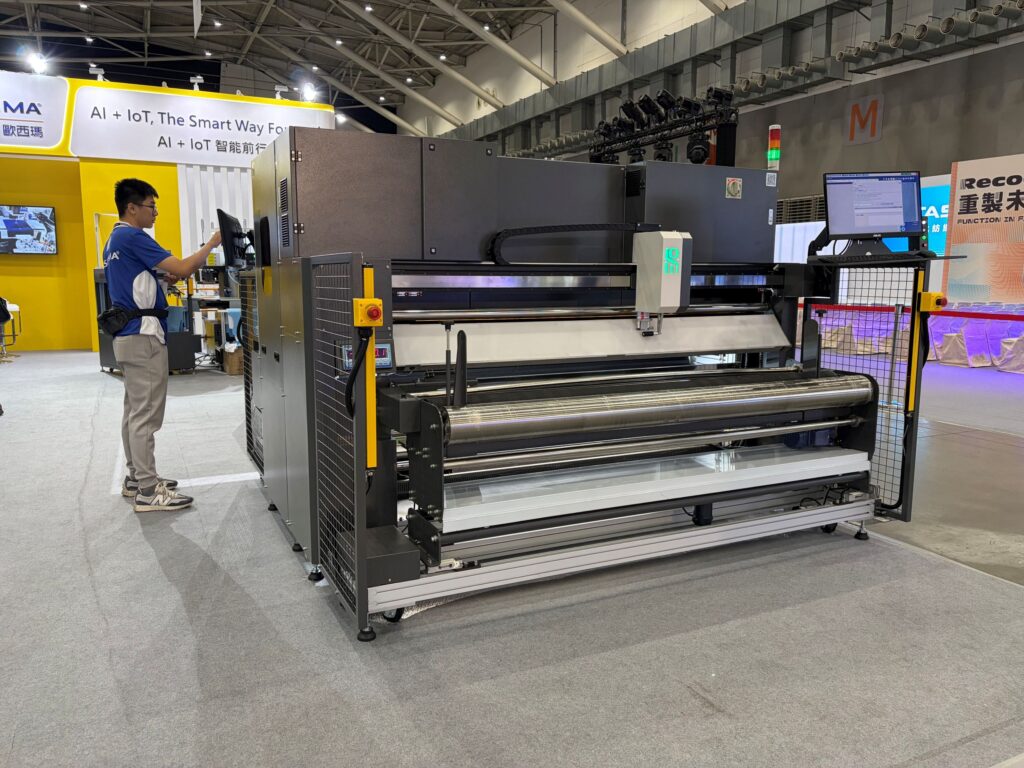
For factories processing expensive fabrics, high ply counts or products with demanding quality requirements, such visibility could help reduce avoidable replacement cutting, rework and material losses. The actual savings would depend on the manufacturer’s fabric costs, defect rates and production conditions.
Connecting the Cutting Room
OSHIMA’s wider ambition is to extend this information beyond the planning stage and into day-to-day cutting-room operations.
Its Smart Factory Platform connects supported inspection and production equipment, allowing manufacturers to access selected machine information, production records and digital applications within a common environment. The company’s SPro intelligent spreading machine incorporates connected production monitoring, while an optional projection system can display cutting-file information and, where EagleAi data is available, recorded defect locations directly on the fabric during spreading.
This allows operators to check known problem areas before cutting, bringing digitally recorded information back into the physical production process.
Mr. Finke believes the effectiveness of such solutions depends on how well the individual elements work together. “It needs to all work together,” he observes, emphasising the importance of connecting inspection, spreading and cutting rather than viewing them as isolated investments.
He identifies Korean manufacturers among those showing particular interest in advanced automation and integrated quality management, especially where stringent product requirements make accurate defect identification and consistent production essential.
The company is also conscious that not every manufacturer is ready to invest in an entire connected system. Equipment such as EagleAi and SPro can perform their principal functions independently, with compatible digital capabilities added as operational requirements develop.
For manufacturers considering automation, this creates a practical distinction between purchasing a machine to solve an immediate production problem and establishing the infrastructure for wider digital integration. Both approaches have a place, but the longer-term benefits increasingly depend on how effectively information can move across the factory.
New Opportunities in Technical Textiles
While connected manufacturing is becoming a central part of OSHIMA’s development, the company continues to broaden the applications of its established machinery portfolio.
Mr. Finke identifies technical textiles and specialised industrial applications, particularly automotive, medical and aerospace-related manufacturing, as important areas of future growth.
These sectors present material-handling requirements that can differ considerably from those encountered in conventional apparel production. Stretch characteristics, fabric weight, thickness, surface properties and dimensional stability can all influence how a material must be spread before cutting.
OSHIMA addresses these requirements through different spreading-machine configurations. Its SPro system is designed for knitted and woven fabrics, while the T5 is intended for tubular knitted materials that require controlled handling to minimise twisting and uneven tension.
For higher-volume applications, the J3 multi-roll spreading system can accommodate up to six fabric rolls in suitable configurations. Its design is relevant to production environments handling protective textiles, medical materials and other applications where repeated, controlled spreading is required.
The company’s F2 Dual-Flow system addresses a different set of requirements, particularly automotive interiors and technical materials such as nonwovens, foam and multilayer structures. Its controlled feeding arrangement is designed to limit unwanted tension and deformation during spreading.
These distinctions are important because automated spreading cannot be approached as a single solution for every fabric. The right equipment depends on material behaviour, production volumes and the requirements of the subsequent cutting process.
The automotive sector is especially significant in Mr. Finke’s assessment. With competitive pressure increasing across the global vehicle industry, suppliers of seats, interior components and related textile products are looking for opportunities to improve productivity and control costs.
He observes that manual fabric spreading remains common in some automotive supply operations, creating scope for greater automation. For OSHIMA, the opportunity lies in helping manufacturers manage materials more consistently while improving the efficiency of processes that may otherwise require considerable manual handling.
Advancing Quality Control Beyond Metal Detection
OSHIMA is also extending its application of intelligent technology to finished-product inspection.
Mr. Finke points to the company’s X-ray inspection systems as an example of how manufacturers can strengthen quality control without necessarily introducing a fully integrated cutting-room system.
Conventional needle detection remains an important safeguard against metallic contamination in garments and sewn products. However, manufacturing processes can also introduce non-metallic foreign objects, including fragments from certain plastic components or other production materials.
OSHIMA’s OX-400 and OX-600 X-ray systems are designed to inspect finished and semi-finished products for concealed foreign objects. Their detection capabilities extend beyond metal to materials such as glass, stone, high-density rubber and selected plastics, subject to the object’s characteristics and inspection conditions.
The equipment also incorporates AI-assisted image processing to support inspection and interpretation of X-ray images.
For Mr. Finke, the broader objective is to make quality assurance more effective while reducing unnecessary interruptions and repeated manual checks. He sees applications of this kind as a possible starting point for manufacturers seeking to introduce more sophisticated inspection technology into an existing production environment.
The distinction is that automation is being directed towards specific quality risks rather than adopted simply for its own sake. For manufacturers supplying demanding international markets, the ability to identify potential contamination before shipment remains an important part of production control.
India at the Centre of OSHIMA’s Growth Plans
India occupies an important position in OSHIMA’s international strategy, both as an established market and as a source of future business opportunities.
Mr. Finke believes the continuing diversification of global garment production, coupled with rising expectations for manufacturing quality and efficiency, creates favourable conditions for machinery suppliers serving the Indian market.
OSHIMA has operated in India for several years and has renewed its collaboration with Ramsons, the Indian garment-finishing equipment manufacturer. According to Mr. Finke, the relationship extends beyond conventional machinery distribution, with the two companies cooperating across their respective equipment businesses.
This approach reflects the importance of local partnerships in a market as geographically diverse as India. Manufacturing requirements vary across industrial clusters, while access to technical assistance, spare parts and timely machinery support can strongly influence purchasing decisions.
Mr. Finke says OSHIMA’s Indian partners maintain stocks of spare parts for selected machines. He also reports that fusing and fabric pre-shrinking equipment is available locally, supporting manufacturers looking to introduce or upgrade these processes.
Fabric preparation is emerging as an important area of interest. As manufacturers place greater emphasis on consistent garment measurements and product quality, equipment for fabric relaxation and pre-shrinking is attracting attention beyond the premium manufacturing segment with which it was once more closely associated.
These processes address different but related concerns. Fabric relaxation helps release residual tension before spreading and cutting, while pre-shrinking uses controlled processing conditions to address dimensional changes that may otherwise affect the finished product.
For Indian manufacturers seeking to improve quality consistency, investment in fabric preparation can therefore be as relevant as upgrading spreading or cutting equipment.
Mr. Finke sees India’s manufacturing capabilities and willingness to adopt new ideas as important strengths. His confidence in the market is clear, although OSHIMA’s ability to translate that opportunity into sustained growth will depend on offering appropriate technologies alongside dependable local support.
The Next Chapter: Making More of Manufacturing Data
Looking beyond individual machinery developments, Mr. Finke sees the information generated by OSHIMA’s growing installed base of connected equipment as a significant resource for future innovation.
The company has developed its own AI capabilities and continues to build its fabric-defect data resources through inspection applications. Mr. Finke believes this accumulated knowledge can help improve the usefulness of its technology, while providing manufacturers with more detailed information about material quality and production.
He describes OSHIMA’s longer-term direction as becoming more of a “data enrichment company”—one that uses information collected through its equipment to help customers make better operational decisions.
It is an interesting direction for a manufacturer whose origins lie in mechanical engineering. Rather than moving away from machinery, OSHIMA is seeking to increase its value by connecting equipment performance with inspection records, planning requirements and production intelligence.
For Indian textile and apparel manufacturers, the relevance extends beyond artificial intelligence itself. Investment decisions increasingly require a clear understanding of how technology will affect material utilisation, product quality, productivity and the ability to manage complex orders reliably.
OSHIMA’s proposition is that these improvements need not come from machinery alone. They can also come from using existing production information more intelligently and ensuring that it remains available when decisions must be made.
For Mr. Finke, that is where much of the company’s future development is heading. And as India’s textile and apparel industry considers its next phase of modernisation, OSHIMA is placing its emphasis on a question that is becoming increasingly relevant to manufacturers: not simply how accurately a machine detects a problem, but how effectively the factory uses that information before the problem becomes a cost.