


By K. Gopalakrishnan
With five decades of engineering expertise, indigenous manufacturing capabilities and a strong focus on automation and sustainability, Prashant Group is strengthening India’s position in the global textile machinery industry. Under the leadership of Ms. Amoli Shah, the company is advancing intelligent, high-performance solutions for weaving preparatory and technical textile applications.

Founded in 1975 by Mr. Prakash Shah, Prashant Group has evolved from a modest engineering workshop into a globally recognised textile machinery manufacturer. Its growth reflects a consistent commitment to delivering world-class technology at appropriate prices, combining international engineering standards with solutions tailored to Indian and global customers.
As the textile industry moves towards higher productivity, automation and resource efficiency, Prashant is strengthening its product portfolio and technological capabilities to address increasingly sophisticated manufacturing requirements.

Indigenous Engineering, Quality and Innovation
Strategic collaborations with Gamatex of Italy, WestPoint of the USA and Ferber of Italy played an important role in Prashant’s evolution, enabling its expansion into sectional warping, sizing, direct warping and automated material handling. Over time, the company has built on this technological foundation through sustained investment in its own R&D and manufacturing capabilities.
“Our vision has always been to provide world-class technology at an appropriate price,” says Ms. Amoli Shah, Director, Prashant Group. “Even when we work with international technology partners, we continue to build on that knowledge and develop our own capabilities.”
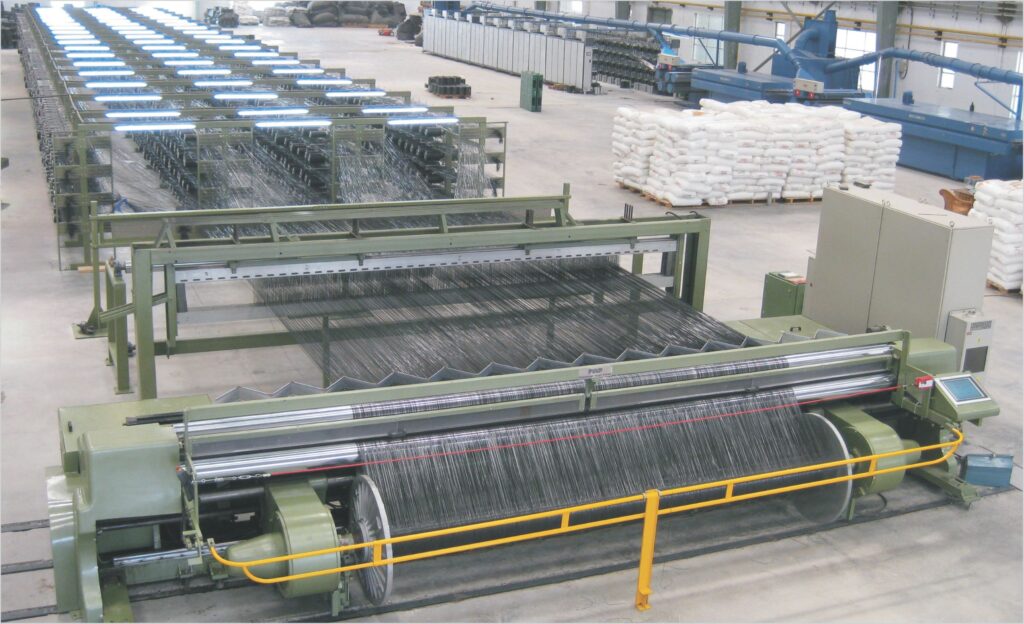
The company manufactures most of its mechanical components in-house, supported by advanced laser-cutting and plasma-cutting systems, CNC bending equipment and robotic welding facilities. It also develops its own machine software, while sourcing specialised components such as motors and drives from external suppliers.
An R&D team of more than 25 engineers works on product development, performance improvements and customer-specific solutions. This integration of design, software and manufacturing gives the company greater control over quality and precision, while enabling faster responses to changing market requirements.
Prashant’s approach is to develop technology rather than merely replicate existing solutions. Its robotic sectional warping machines, for example, automate operations and can improve productivity by nearly 50%, while reducing labour requirements and floor-space consumption.
A Comprehensive Portfolio for Diverse Applications
With more than 50 products and models, Prashant offers solutions across sectional warping, direct warping, sizing, indigo dyeing, beam handling and storage, inspection and material handling. Its machinery caters to cotton, polyester, viscose, jute, filament yarns and specialised technical materials, including fiberglass.
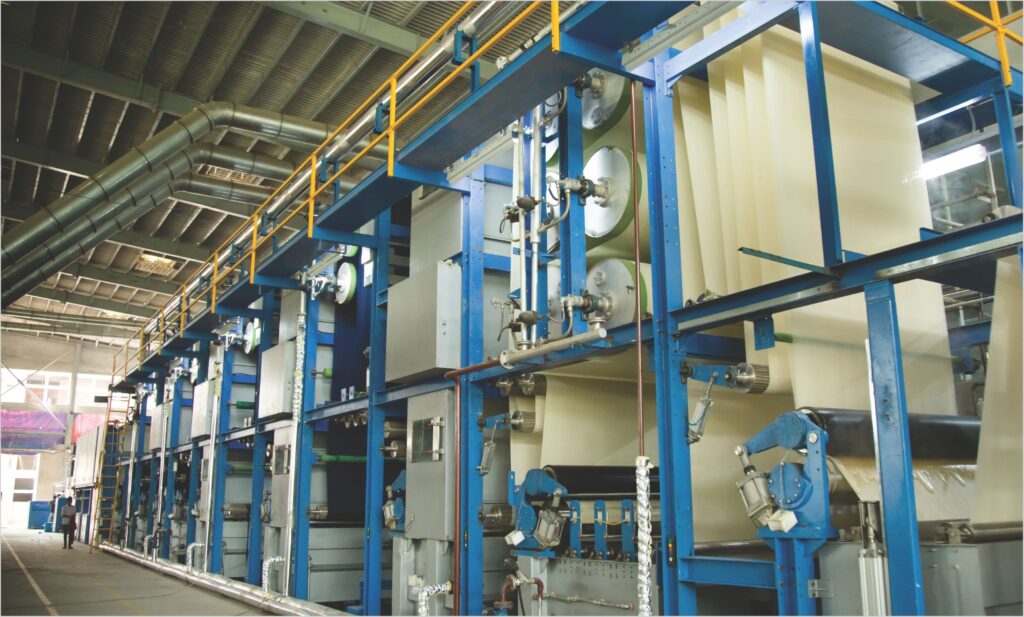
The company introduced specialised poly beamers in 2005 to address direct-beaming requirements in technical textiles. Its split-warping machines for monofilament applications further expand its capabilities, particularly for customers in Surat and other weaving clusters.
Prashant’s indigo sheet-dyeing technology, incorporating Nitro technology, is another significant development. By conducting dyeing in an inert environment, the system reduces the number of tanks required from eight to approximately two or three. This can deliver water savings of around 60%, alongside lower chemical consumption and reduced space requirements.
Customer collaboration has also driven specialised developments in fiberglass processing. Responding to a customer’s challenge, Prashant engineered a solution that eliminates sizing for selected denier applications. The development required several months of design and engineering work, but offers the potential to reduce water, energy and chemical consumption.
“We enjoy taking up challenges from customers,” Ms. Shah explains. “When a customer approaches us with a specific requirement, we work on developing a solution that meets the application’s needs.”
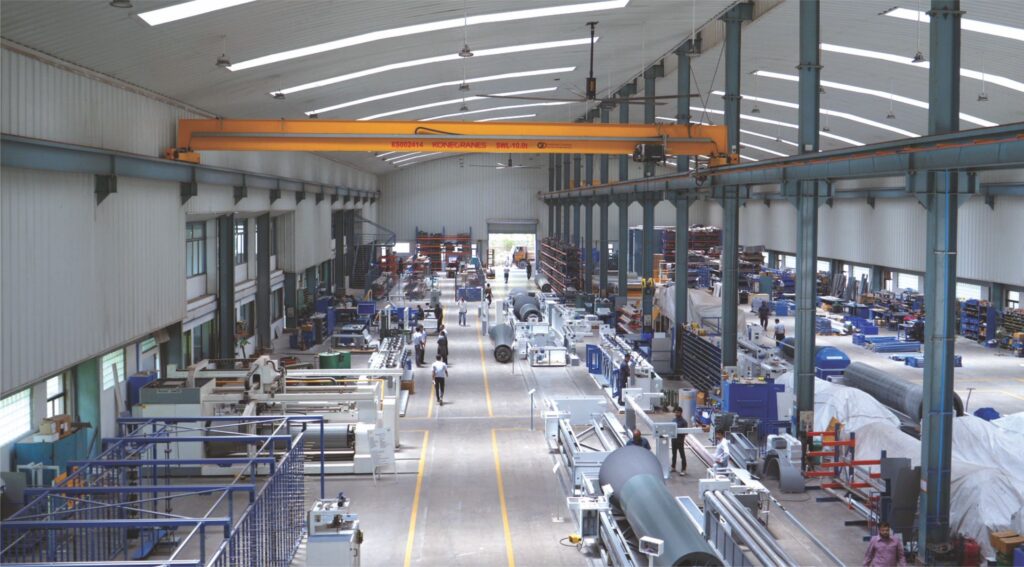
Such innovations demonstrate the company’s ability to address specific production challenges while improving operational efficiency and environmental performance.
Competing with Global Machinery Leaders
Prashant’s presence alongside established international machinery brands in major textile manufacturing facilities reflects the growing capabilities of Indian engineering. Competing with global leaders requires consistent quality, reliable performance, sophisticated technology and responsive customer support—not price competitiveness alone.
The company’s evolution illustrates how international partnerships can provide a technological foundation, while indigenous R&D creates lasting differentiation. Its robotic sectional warping machines, specialised poly beamers and advanced indigo-dyeing solutions demonstrate a willingness to invest in technologies ahead of widespread market adoption.
Recalling the development of its robotic sectional warping machine, Ms. Shah highlights the importance of sustained investment and customer confidence. The technology initially attracted a limited number of buyers, but wider acceptance followed as manufacturers recognised its productivity and automation benefits.
“Sometimes, when we introduce a new technology, only a few customers understand its potential initially. Over time, as its benefits become evident, more customers adopt it,” she says.
The company’s experience also highlights the opportunity for India to expand its textile machinery manufacturing capabilities beyond spinning. Precision engineering, a strong supplier ecosystem and continuous technological investment will be essential to developing competitive domestic alternatives in other machinery segments.
INDIA ITME 2026: Showcasing Advanced Solutions
For Prashant, INDIA ITME 2026 is an important platform to demonstrate its latest technologies and engage directly with textile manufacturers, promoters, plant heads and purchase decision-makers.
“INDIA ITME is a very important exhibition for us because it brings together the people who make investment and technology decisions in textile manufacturing,” says Ms. Shah. “It gives us an opportunity to showcase our latest technologies and interact directly with customers.”
The company plans to showcase developments in sizing and indigo sheet dyeing, alongside inspection technology, sampling solutions and its new reed-cleaning machine, which addresses a gap in the Indian market. Selected models and live demonstrations will highlight the breadth of its technological capabilities.
Automation will be another important theme. Through its association with Ferber, Prashant provides beam handling and storage systems, conveyor solutions, inspection equipment and fabric-roll management systems. These solutions help mills improve material flow, reduce manual intervention and strengthen process control.
The exhibition comes at a time when Indian textile manufacturers are investing in man-made fibres, technical textiles and modernisation. For Prashant, it offers an opportunity to demonstrate how advanced Indian machinery can meet these evolving requirements while competing with international alternatives.
Sustainability and Intelligent Manufacturing
Sustainability is increasingly influencing textile machinery design, and Prashant is addressing it through both product innovation and its manufacturing operations.
Besides the water and chemical savings offered by Nitro technology, its specialised fiberglass solution can eliminate sizing for certain applications, avoiding the associated desizing process and resource consumption. Servo technology across much of its machinery portfolio further helps reduce power wastage.
At its facilities, the company has invested in rooftop solar power, tree plantation initiatives and an environmentally designed building that has received green-building certification.
Digitalisation is the next frontier. Prashant has incorporated Industry 4.0 capabilities into its machinery and is developing applications involving data integration, operational reporting and maintenance. Its automated material handling solutions can also track storage periods and prevent the retrieval of materials that have exceeded specified usage limits, supporting quality assurance and traceability.
While AI integration remains a work in progress, the company sees considerable potential in data analysis, intelligent maintenance and smarter machine operation. Making these capabilities more accessible and user-friendly will be an important part of its technology roadmap.
The Road Ahead
Although geopolitical uncertainty has slowed exports in recent years, domestic demand has remained strong. Prashant continues to serve international markets across more than 50 countries, while looking to capitalise on opportunities in technical textiles, man-made fibres and higher-value textile manufacturing.
Its future strategy centres on automation, AI, sustainability and continuous product development. The objective is to make weaving operations more productive and efficient, reduce resource consumption and deliver increasingly intelligent machinery.
“Our focus will increasingly be on automation, making our machines smarter and more intelligent, and reducing the carbon footprint wherever possible,” Ms. Shah says. “There is always scope to improve, and we have to keep upgrading our technology.”
For Prashant Group, five decades of engineering experience provide the foundation for the next phase of growth. By combining indigenous manufacturing strength, customer-led innovation and global technological standards, the company is reinforcing the role of Indian machinery manufacturers in the evolving textile industry.