


With 100% of its ring and open-end spinning machinery now connected to its AI-based data analytics platform, The Mill Mind, Sri Kannapiran Mills is converting machine data into actionable intelligence to improve productivity, quality and operational responsiveness — without investing in new equipment.
For years, textile mills have installed sophisticated monitoring systems across spinning and weaving operations. However, the availability of data does not necessarily translate into better decision-making. Mr. Srihari Balakrishnan, Managing Director, Sri Kannapiran Mills, believes the industry has historically collected enormous amounts of machine data without fully exploiting its potential.
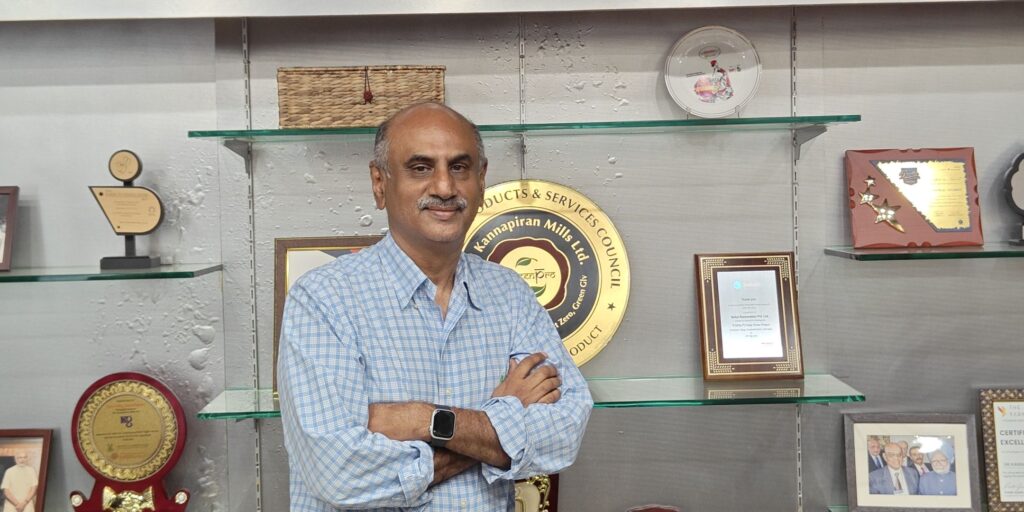
“As spinners we all have and had data monitoring equipment. Spindle monitoring, carding monitoring, preparatory monitoring etc. Like most of us we were using it as an ornament, not using the data. Not analysing it, not mining it, not drilling down to first principles,” he says.
Sri Kannapiran Mills is now attempting to bridge that gap through The Mill Mind, its AI-based data analytics platform.
100% Spinning Capacity Under AI-Based Monitoring
The company has now connected its ring and open-end spinning machines across all four spinning locations to The Mill Mind. Data from the machines flows continuously into the platform, where it is analysed for consistency and deviations.
Depending on the process, alerts are generated either immediately or at the end of a shift or day, allowing manufacturing teams to act on abnormal machine behaviour much faster.
The impact has been particularly visible in spindle performance. According to Balakrishnan, abnormal spindles have fallen to less than 1% in ring spinning and 0.2% in open-end spinning, compared with almost 10% earlier.
“Today 100% of the yarn capacity at Kannapiran spinning goes through our AI data platform and all and any drifting equipment is put back to normal within minutes of a shift ending or turning rogue,” he says.
The objective is therefore not simply to monitor machines, but to identify deviations and enable timely corrective action.
Measurable Gains Without New Equipment
The company reports significant improvements across its manufacturing operations over the past year. Spinning productivity has increased by 6%, weaving quality by 3% and weaving efficiency by 2%. Customer complaints across spinning and weaving have fallen by 90%, while on-time delivery has reached 99%.
Importantly, these gains have been achieved without installing new machinery.
The approach focuses on extracting greater performance from existing assets by analysing the data they already generate and identifying deviations that might otherwise remain unnoticed.
“All achieved without a single new equipment,” says Balakrishnan.
Data Also Strengthens the Manufacturing Team
The Mill Mind is also changing how manufacturing personnel interact with machine data. Anomalies are delivered directly to the phones of technicians and other manufacturing personnel, enabling them to respond to issues while building knowledge from actual machine behaviour.
Balakrishnan believes this has helped address the industry’s shortage of skilled technical manpower.
“Our manufacturing teams capability, enhanced multi fold because they get anomalous data delivered to their phones, for action to be taken and learnings to be had. Our talent crunch has been transformed into a gifted talent pool trained by live data analytics,” he says.
The platform effectively creates a continuous learning environment in which technical teams can use real-time information to understand and resolve operational deviations.
The Mill Mind Extends Beyond Kannapiran
Sri Kannapiran Mills has also begun testing The Mill Mind with other spinning companies. Thirty mills with ring-spinning operations were invited to try the platform’s MVP on a cost-to-cost basis.
According to Balakrishnan, almost all have experienced efficiency improvements ranging from 2% to 12%, again without adding new equipment.
The platform is now operating across approximately 600,000 spindles outside Sri Kannapiran Mills’ own 55,000 spindles and 6,000 rotors, while empowering more than 1,000 technicians, fitters and electricians with machine data.
This indicates a transition from an internally developed optimisation tool towards a broader technology platform for textile manufacturing.
Towards Vertical SaaS for the Textile Industry
Balakrishnan sees the evolution of The Mill Mind as part of a wider shift towards industry-specific AI solutions.
“In the age of AI it’s time for vertical SaaS with deep domain knowledge,” he says.
For textile manufacturing, such platforms can potentially go beyond individual machine monitoring by connecting data across processes and identifying relationships between them.
The company’s next objective is to connect equipment across the textile value chain, including spinning, autoconers and looms, and cross-reference the resulting data.
“In the next few years, we will be connecting equipment back and forth the textile value chain for better product quality visibility. Cross referencing data, spinning with Autoconer and loom and triaging this data,” he explains.
Such connectivity could provide manufacturers with a broader view of process performance and help identify the source of quality or efficiency deviations across interconnected operations.
From Monitoring to Actionable Intelligence
For Balakrishnan, the fundamental issue is whether mills are actually extracting meaningful intelligence from their existing monitoring systems.
His message to spinners is direct: having a monitoring system does not necessarily mean that its full potential is being used.
“If you have spinning monitoring equipment and you believe you are fully using it. Then talk to us for, what you see is not at all what it is!!!” he says.
The Mill Mind represents Sri Kannapiran Mills’ effort to move the industry from simply collecting machine data towards analysing it, identifying anomalies and acting on them quickly.
For an industry where productivity, quality, consistency and machine utilisation directly influence competitiveness, the experience at Sri Kannapiran Mills points to an important emerging opportunity: using AI and deep domain analytics to unlock more performance from the machinery already installed on the factory floor.