


Data has become a strategic asset across the entire value chain of the global Textile Machinery business. Anand Kalidasan, a consultant in the field of AI & ML, provides an overview of the state of play in data driven decision making at the ITMA Asia 2025.

Artificial Intelligence is beginning to help with Textile fabric defect detection . These complex mathematical algorithms are called Deep Learning Algorithms. They evolved from older image classification algorithms which rely on extensive training data in the form of fabric-defect images and fabric-without-defect images. There is continuous progress in good quality training image libraries of defects across fabric types and the field of AI Computer Vision for Textile industry is not a futuristic technology but likely to be a core determinant in textile machinery purchases now.
Early Computer Vision experiments
AI Computer Vision is the field of image based classification using deep learning algorithms. The following textile datasets are available in public data repositories thanks to researchers across the world and are being used by Deep Learning data scientists for training complex fabric defect detection algorithms
- AITEX fabric Image database : (Silvestre-Blanes et al., 2019) : a training image library of 245 fabric images with multiple defect classes
- Ten Defects Dataset : Shakir, S., Topal, C. Unsupervised fabric defect detection with local spectra refinement (LSR). Neural Comput & Applic (2023). Features 27 different defect types across 10 fabric types
- Fabric Stain Dataset : Intellisense Lab of University of Moratuwa, Sri Lanka. 450+ Fabric Stain images that capture Ink stain, Oil stain, Dirt Stain
- Women Fabric Defect Detection (WFDD) : 4100 images of multiple fabric origins and types
Data scientists around the world are able to use these datasets to train deep learning algorithms to classify the defects by fabric type. The defect detection classification accuracy depends on the diversity and volume of the training images both no-defect and defect image from mill owners or textile machinery manufacturers.
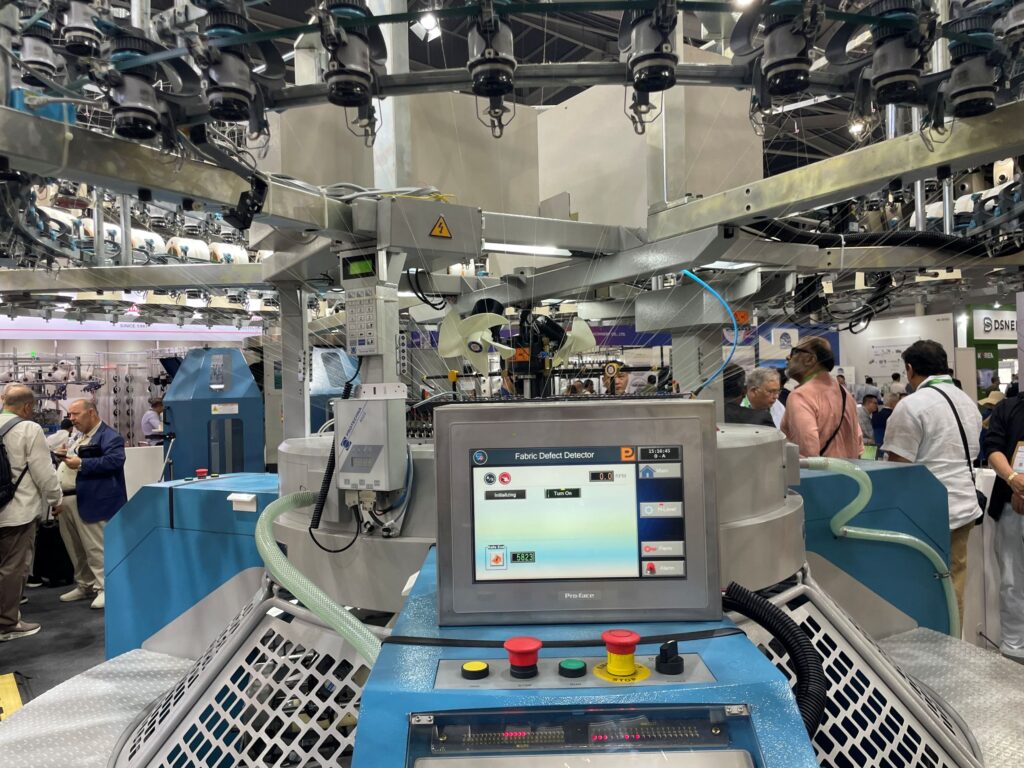
AI computer Vision needs Investments
The journey to AI computer vision for fabric defect detection requires investments from both machinery manufacturers and mill owners. Most machinery manufacturers are already investing in to Data engineering teams who are partnering with external AI computer vision vendors or developing inhouse vision systems. The cost involved in AI Computer vision is a reality and the sooner mill owners and machine manufacturers make this investment, the faster they build competitive advantage. Once they are beyond prototypes, these AI computer vision systems will set the stage for plugging labor gaps and increased profits due to reduction in fabric defects. The intangible benefits of customer appreciation and goodwill also must be considered when deliberating AI computer vision investments.
The Textile Magazine has partnered with Anand Kalidasan to provide consulting services for Textile Machinery Manufacturers and Factory owners. For consulting queries, please contact anand.kalidasan@gmail.com