


Across the global textile industry, mills are under pressure to make fabric finishing more efficient: using less energy, less water, less chemical use, less downtime, and less capital tied up in new production capacity. Yet finishing remains essential to product performance, hand feel, and customer acceptance, making it difficult to change without risking quality. Conventional methods often rely on high wet pick-up, large volumes of water, significant chemical use, and substantial drying energy. In a market where energy costs remain unpredictable and margins are under pressure, mills are looking for ways to improve fabric treatment efficiency without compromising quality.

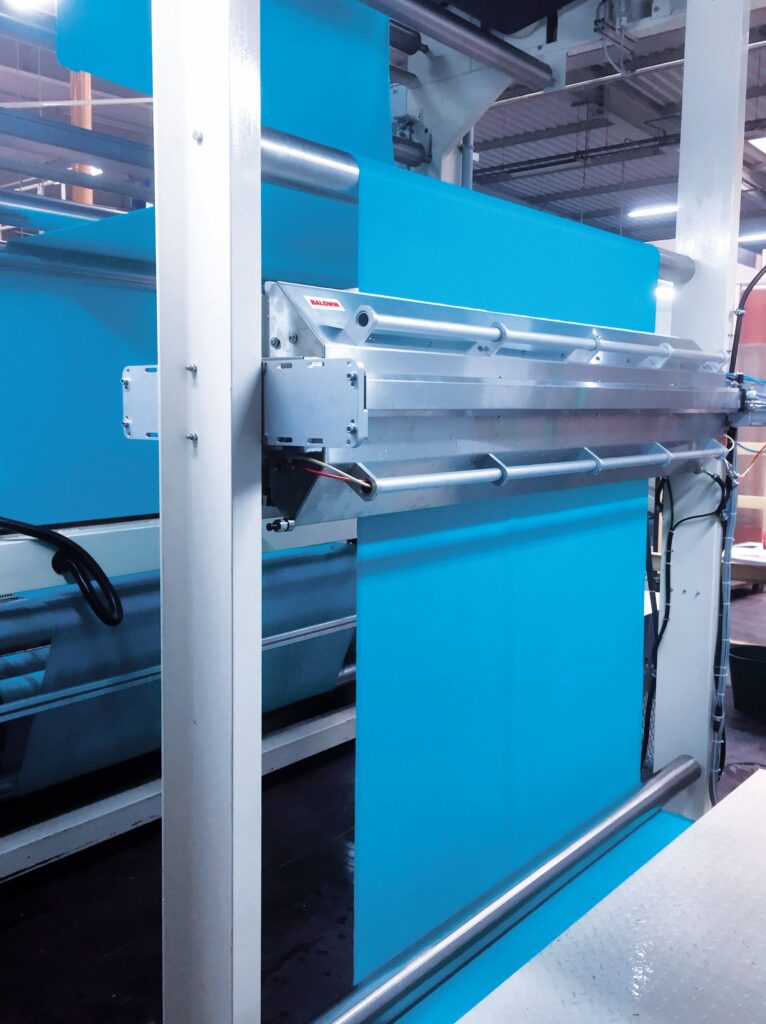
BW Converting’s Baldwin TexCoat® G4 precision spray finishing system was developed to help textile producers rethink how chemistry is applied to fabric. Instead of relying on traditional bath-based application methods, TexCoat G4 uses non-contact Precision Spray Application Technology to deliver the required chemistry directly to one or both sides of the fabric. By applying only what is needed, where it is needed, the system can significantly reduce wet pick-up, helping mills lower water and chemical usage while reducing the energy required for drying.
For many textile producers, the value of this approach is now being proven in production. BW Converting has seen rapid adoption of Baldwin TexCoat G4 across key textile-producing regions, with more than 30 installations in Pakistan alone and growing interest across Asia, Europe, and other markets where mills are focused on improving productivity, lowering operating costs, and making more efficient use of existing production assets.
“Textile producers are increasingly looking for technologies that solve more than one problem at the same time,” said Yiannis Vasilonikolos, Global Sales Leader for Textiles, BW Converting. “With Baldwin TexCoat G4, mills can reduce water, chemistry, and energy consumption, but they can also improve consistency, finishing quality, and production efficiency. That combination is why the technology has gained such strong momentum in the market.”

This business case is especially important. Sustainability remains a major priority for the global textile supply chain, but for mills, environmental gains must also translate into measurable operating advantages. For textile producers, the value proposition is rooted in performance. Reducing water, energy, and chemical consumption can lower production costs, while improved application control can help increase output, strengthen consistency, and generate more saleable fabric from existing equipment.
TexCoat G4 is designed to support that production strategy. Because the system reduces the amount of water applied to the fabric, mills can reduce the drying load on the stenter. In many cases, that means the line can run faster without increasing energy use. For mills facing capacity constraints, this can be a critical advantage. Rather than immediately investing in a new finishing line, producers are able to unlock additional throughput from the equipment already on the floor.
At Zaman Textile Mills in Pakistan, the technology has delivered measurable results. The company has used Baldwin TexCoat G4 to support its goals for higher productivity, improved finishing quality, and more resource-efficient production. According to Atif Siddiqui, Technical Director, Zaman Textile Mills, the system has helped the mill reduce utility and chemical consumption while maintaining required finishing standards.
“Our data indicates that after the first year of installation of the Baldwin TexCoat G4 system, water and energy consumption have decreased while maintaining Zaman’s required finishing standards,” Siddiqui said. “Compared with machines not equipped with TexCoat G4, we have achieved 30 percent more production with the system’s aerosol spray technology. Chemical usage has also decreased by up to 50 percent compared to our earlier methods. Compared with the conventional method, Baldwin TexCoat G4 improves the hand feel of the fabric and the overall quality of the finished product.”
These results speak to a broader market reality. Textile manufacturers are under pressure to become more efficient, but capital investment decisions are being influenced by immediate operating pressures: volatile energy costs, rising labor and chemical prices, competitive export markets, and customers that demand consistent quality. Technologies that help mills reduce consumption while improving output have a much stronger path to adoption than technologies positioned only around environmental benefit.
This is one reason that precision spray finishing has become relevant across multiple textile markets. In high-volume woven applications, reduced wet pick-up can help mills improve throughput and lower drying demand. In apparel and home textile production, more controlled chemical application can support consistency and hand feel. In technical textiles, upholstery, laminated fabrics, and other specialty applications, single- or dual-sided application can help producers target chemistry more precisely and avoid unnecessary processing steps.
TexCoat G4 also addresses common concerns around spray application. Historically, aerosol-based chemistry application raised questions about containment, operator safety, and process control. BW Converting designed the system to capture and enclose the spray application area, creating a controlled process environment. Automated cleaning routines help support uptime, while recipe control and production data exchange help mills reduce manual input, improve repeatability, and maintain greater traceability from batch to batch.
For global textile manufacturers, that level of control is increasingly important. Finishing is not simply the last step in production. It is a quality-defining process that affects fabric performance, customer satisfaction, production cost, and resource consumption. Small improvements in wet pick-up, chemistry control, line speed, or drying demand can have a significant impact across a mill’s overall operating structure.
BW Converting’s experience with TexCoat G4 also reflects a larger trend in textile machinery: mills are looking for retrofit-friendly technologies that can improve existing assets rather than requiring major line replacement. The ability to add precision spray finishing to current production infrastructure gives mills a practical path to modernization, especially in markets where capital investment decisions are being scrutinized more closely.
As adoption expands, Baldwin TexCoat G4 is helping shift the conversation around textile finishing. The question is no longer simply how mills can reduce environmental impact. It is how they can build more efficient, more flexible, and more profitable finishing operations while meeting the expectations of brands, regulators, and end users.
For BW Converting, the success of TexCoat G4 demonstrates that sustainability and production performance do not have to be competing priorities. When chemistry is applied with greater precision, mills can reduce waste, improve consistency, lower drying demand, and increase the value of the finishing line. In a global textile industry defined by cost pressure, quality expectations, and resource constraints, that combination gives mills a practical path to stronger and more efficient production.