


By K. Gopalakrishnan
With major investments in manufacturing, localisation, automation and R&D, Mallcom is strengthening its head-to-toe PPE portfolio to capture the structural growth of India’s and the global safety-equipment market

The personal protective equipment (PPE) industry is entering a period of structural growth, driven by industrialisation, infrastructure development, tighter workplace safety regulations and rising awareness of worker welfare. For Mallcom India Ltd., this changing environment is creating an opportunity to move beyond being a supplier of individual safety products and emerge as an integrated head-to-toe protection partner.
The company has strengthened its manufacturing platform through its largest investment programme to date, while simultaneously expanding its product portfolio, localising previously imported products, introducing automation and accelerating R&D in advanced protective materials and technologies.
Managing Director Ajay Mall believes the opportunity extends well beyond conventional market growth. In India and across the developing world, millions of workers continue to enter industrial environments without adequate protection. At the same time, occupational safety infrastructure is maturing, regulations are strengthening, compliance requirements are tightening and awareness is increasing. The formalisation of safety practices, implementation of BIS standards and expansion of organised supply chains are gradually creating a larger market for quality-certified PPE providers.

PPE market enters a structural growth phase
The global PPE market was valued at US$90.4 billion in 2025 and is projected to reach US$159.8 billion by 2033, representing a CAGR of 7.4% during 2026–2033. Industrialisation, infrastructure and manufacturing expansion, healthcare demand, greater awareness of occupational safety and stricter workplace regulations are among the principal growth drivers.
India represents a significant growth market. The country’s PPE market was valued at US$2.8 billion in 2025 and is expected to reach US$4.8 billion by 2034, registering a CAGR of 5.68% during 2026–2034. Construction, manufacturing, infrastructure, healthcare, logistics, oil and gas and other industries are expanding the application base for PPE, while stronger enforcement of workplace safety norms is supporting demand for certified products.
The market is also becoming more sophisticated. Manufacturers are focusing increasingly on lightweight, ergonomic and high-performance products, while sustainability and smart technologies are creating new areas of innovation.
India’s wider industrial expansion provides an important catalyst. Government capex of more than ₹12.2 lakh crore is projected for FY 2026–27, while more than 100 million people work across manufacturing, construction, mining and logistics. Construction alone employs more than 70 million workers and is projected to reach 100 million by 2030. Manufacturing is projected to contribute US$1 trillion to the economy by 2030.

As industrial activity expands, the requirement for certified protective equipment is expanding alongside it.
₹104.87-crore investment transforms manufacturing platform
Mallcom’s most significant strategic development has been the operationalisation of its largest investment programme, comprising the expansion of its Chandipur facility and commissioning of a greenfield facility at Sanand, Gujarat. Together, the projects represent cumulative investments of approximately ₹104.87 crore.
The investments have transformed Mallcom’s manufacturing capabilities from a collection of strong individual categories into an integrated PPE platform covering footwear, workwear, head protection and gloves.
The new infrastructure provides visibility to support approximately ₹1,000 crore in revenues without proportionate incremental capital investment, according to the company. The focus now shifts from capacity creation to utilisation and productivity.
The projects were funded entirely through internal accruals, without equity dilution or a meaningful debt burden, reflecting the company’s approach of making long-term investments while maintaining financial discipline.
Integrated manufacturing becomes a competitive advantage
Executive Director Giriraj Mall describes the company’s integrated, multi-product and multi-site manufacturing platform as a competitive foundation built over decades and significantly expanded in recent years.
The strategic value of this integration is particularly relevant as procurement practices among large industrial customers evolve. Companies in construction, infrastructure, oil and gas, mining, manufacturing and logistics are increasingly looking to consolidate their safety supply chains around fewer capable, reliable and compliant suppliers.
Mallcom can provide footwear, workwear, head protection and gloves through a single organised, quality-certified and auditable supply relationship—giving customers a comprehensive head-to-toe protection proposition.
Scale across key PPE categories
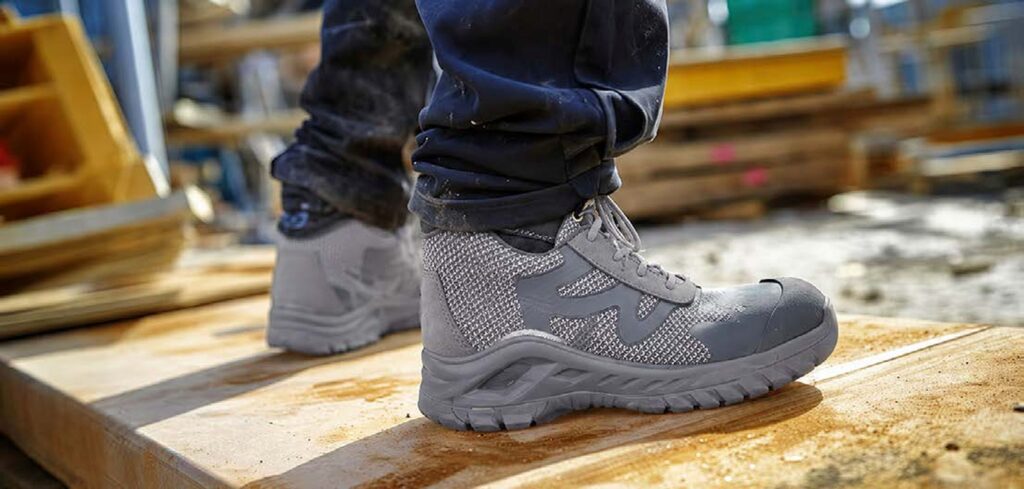
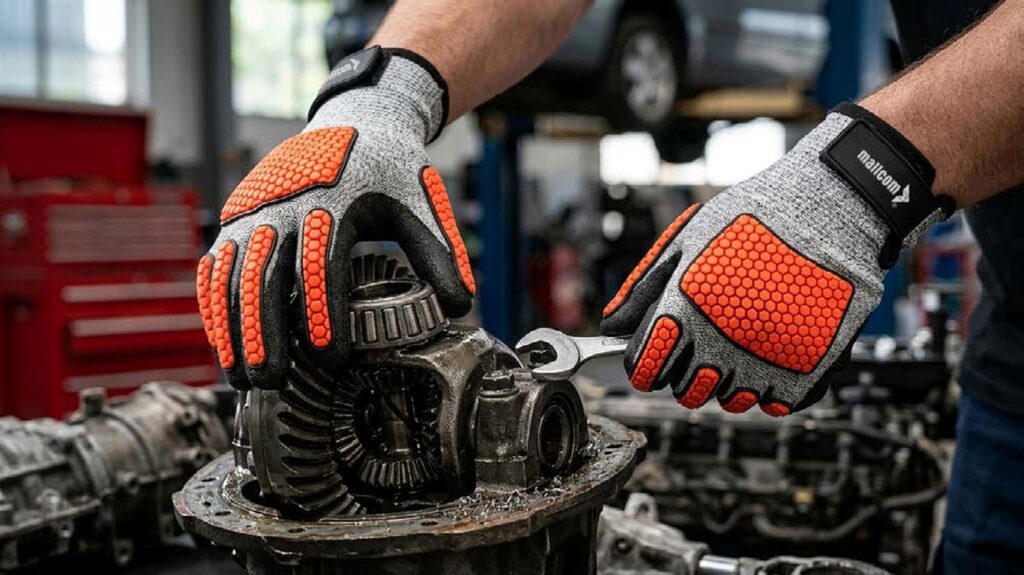
Mallcom’s manufacturing portfolio spans safety helmets, PU-coated and NBR gloves, apparel and industrial safety shoes. Current annual capacities include approximately 1.2 million safety helmets, 2.5 million PU-coated gloves, 17 million NBR gloves and four million pairs of shoes.
The company’s capabilities cover textile, leather, rubber and plastics, with products ranging from leather and knitted gloves to nitrile and PU-coated gloves, helmets, garments and safety footwear. Its access to treated leather through its own tannery provides greater control over an important raw material for gloves and footwear.
Following the commissioning of Sanand, Mallcom has 17 manufacturing units, creating a geographically distributed production platform to support its growing portfolio and domestic and international customers.
Sanand drives localisation
The Sanand facility, where Mallcom has invested more than ₹100 crore, incorporates NBR and PU glove-dipping lines, injection moulding, glove printing and other capabilities. The facility strengthens domestic supply-chain capabilities and enables production closer to customers.
Importantly, Sanand has enabled Mallcom to localise products that were previously imported. This is particularly relevant to gloves, a category historically dominated by imports because of its complexity, specialised materials and the cost competitiveness of Asian manufacturers.
The localisation strategy supports both supply-chain security for customers and the broader shift towards domestic manufacturing.
Footwear and head protection gain momentum
Footwear emerged as one of Mallcom’s strongest-performing categories, with robust domestic and export demand. Increasing certification requirements in India and international markets favour manufacturers with established quality systems and the ability to meet evolving standards.
The company has developed new moulds for sport-inspired safety footwear and refreshed its gumboot portfolio. CAD-based validation, prototype trials and supplier collaboration are being used to assess comfort, performance, affordability and scalability. Its occupational footwear portfolio is developed in line with IS 15298 requirements.
Head protection capacity also became fully operational, adding an important component to the integrated portfolio. The opportunity is closely linked to India’s infrastructure development, including construction, power, roads, railways and urban projects, all of which require certified head protection at scale.
R&D targets advanced protection and greater comfort
Mallcom’s innovation programme is focused on making PPE more protective without compromising comfort, dexterity or usability.
During FY 2025–26, its hand-protection R&D advanced graphene-enhanced polyethylene yarns and evaluated tungsten reinforcement for cut-resistant gloves, supporting the development of lighter and more dexterous products. The company also developed an NBR-coated gauntlet combining cut, heat and chemical protection.
In body protection, Mallcom advanced flame-retardant fabrics, breathable high-visibility vests and arc-flash layering systems using warp-knit, mesh and tricot structures to improve airflow and durability. RFID-based traceability has also strengthened production visibility and customer assurance.
The product pipeline includes BIS-certified FR and high-visibility products and the NC Flash range. PU and NBR seamless gloves are also being developed for IS 6994 certification.
In footwear, new designs are being developed through CAD validation, prototype trials and supplier collaboration, with emphasis on protection, ergonomics and manufacturability.
Automation strengthens process control
Manufacturing expansion is being accompanied by selective automation. Mallcom is deploying automated CNC cutting, automated Velcro attachment and digitally controlled packaging processes to improve precision, batch consistency and productivity.
The objective is not automation for its own sake, but the targeted application of technology where it can reduce manual intervention and improve quality, repeatability and process control—particularly important in a highly regulated PPE industry.
The company is also investing in workforce development. Its Stitching Training School develops women operators and creates a pool of trained manufacturing personnel, with successful trainees subsequently joining Mallcom’s production facilities.
Preparing for the next phase of growth
With the major capacity expansion completed, Mallcom’s focus is now shifting towards utilisation, branded sales and market expansion.
Key priorities include improving utilisation across facilities, strengthening branded sales in India, Africa and the Middle East, expanding distribution and customer relationships, and capturing the operating leverage offered by its larger manufacturing base.
The company’s future R&D agenda includes ventilated helmets, cut-resistant gloves, flame-retardant garments and contemporary safety footwear, alongside deeper material research, digital traceability, shorter development cycles, greater automation and alignment with evolving BIS and international standards.
Established in 1983, Mallcom has developed into a PPE manufacturer and exporter with a head-to-toe portfolio, globally certified manufacturing facilities and in-house testing laboratories. Its products reach more than 50 countries across six continents.
The combination of India’s industrial expansion and rising workplace safety expectations creates a substantial long-term opportunity. For Mallcom, the foundations have been strengthened through investment, manufacturing integration, localisation, automation and innovation.
The next phase is about converting that manufacturing depth into scale—building Mallcom into an increasingly comprehensive, technology-driven and globally competitive PPE partner as India’s industrial and infrastructure ambitions gather momentum.