


By K. Gopalakrishnan
With a 55-tonne-per-day manufacturing facility in India, expanding synthetic capabilities, new investments in technology and a diversified global footprint, Teejay is positioning India at the heart of its next phase of growth
The Teejay story began in 2000 with an ambitious objective: to build a world-class knit-fabric manufacturing operation in Sri Lanka. Twenty-five years later, Teejay Lanka PLC has grown into South Asia’s largest knit-fabric provider and Sri Lanka’s only multinational weft-knit manufacturer, with a manufacturing footprint spanning Sri Lanka, India, Bangladesh, Egypt and Indonesia, complemented by an investment and trading arm in Mauritius.
The Group’s evolution is increasingly being shaped by a strategy of geographical diversification, product transformation, digitalisation and sustainability. Among its international operations, Teejay India (TJI) is assuming particular importance, both because of its scale and because India is emerging as an increasingly important sourcing and manufacturing destination for global apparel brands.
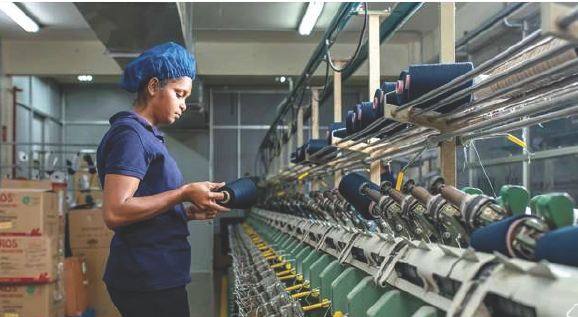
Operating since January 2009 within Brandix India Apparel City, an export-oriented Special Economic Zone, Teejay India today has a 55-tonne-per-day capacity and manufactures cotton and cellulosic blends, synthetic nylon and polyester fabrics, fleece and lace, besides offering discharge, pigment, super-soft and reactive printing capabilities.
India at the Centre of the Next Growth Phase
Teejay’s strategy for India has evolved beyond simply establishing a manufacturing presence. The company is increasingly using the Indian operation as a strategic production and supply-chain hub.
During 2025/26, global trade disruptions and tariff uncertainty affected capacity utilisation at Teejay India. US tariffs on Indian textile imports initially reached 50%, placing the Indian operation at a competitive disadvantage, particularly given that it represents the Group’s largest single production facility.
However, Teejay responded by accelerating productivity improvements, cost optimisation and portfolio diversification. The company also successfully increased utilisation of its synthetic capacity, improving profitability and strengthening the facility’s ability to absorb changing global orders.
The Group believes these investments will become increasingly valuable as international brands diversify their sourcing under the China Plus One strategy and seek to reduce concentration risks in traditional manufacturing locations.
Teejay’s multi-country footprint provides an additional advantage. With operations now established in Egypt and Indonesia alongside Sri Lanka, India and Bangladesh, the Group can offer customers greater flexibility in sourcing and production while mitigating regional disruptions.
Moving Towards Higher-Value Fabrics
A key element of Teejay’s future strategy is a shift from conventional fabrications towards higher-value, technical and niche products.
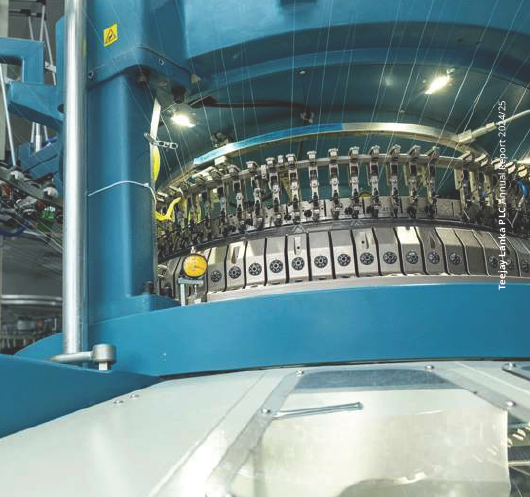
The Group is expanding its capabilities in sophisticated jacquards, complex fabric structures, flat knits, lace dyeing and other specialised constructions. Its innovation brand, INSCOPE, is being developed to capture opportunities in higher-margin performance and functional fabrics.
This product transformation is particularly relevant to India, where the textile and apparel industry is increasingly moving towards MMF, sportswear, athleisure and performance-oriented products.
Teejay India’s existing portfolio already includes synthetic nylon and polyester fabrics alongside cotton, cellulosic blends and fleece. The company’s decision to increase synthetic capacity utilisation reflects its recognition of the growing importance of man-made fibres in global apparel sourcing.
Technology Driving Manufacturing Excellence
Teejay is simultaneously investing in technology to improve productivity, quality and manufacturing flexibility across its global operations.
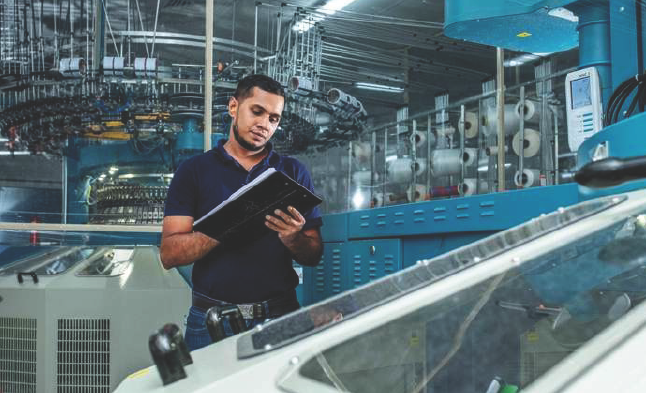
The company has embedded Industry 4.0 technologies across its manufacturing network, with IoT devices installed across knitting machines and utility points. These systems enable real-time monitoring of machine performance, utility consumption, stoppages and other critical production parameters.
The Group has also integrated its knitting fleet into a smart digital network developed in partnership with Xdoto. Machine data is transmitted wirelessly and made available through digital dashboards, providing visibility into machine utilisation, yarn and elastane breakages, stoppage causes, quality indicators and Overall Equipment Effectiveness (OEE).
Artificial intelligence-assisted quality monitoring, Robotic Process Automation and platforms such as Microsoft Power BI and SAP Fiori are further improving decision-making and reducing waste.
For Teejay India, these technologies are particularly important as the company seeks to improve competitiveness and absorb a wider range of high-value orders.
Investments in Capacity and Capability
Teejay’s capital investments during the year have focused not merely on increasing capacity but on upgrading the quality and technological sophistication of its manufacturing base.
The Group has invested in state-of-the-art knitting, dyeing and finishing machinery, with the objective of improving throughput, enabling higher-value products and reducing manufacturing costs through automation and digitalisation.
Modern machinery is also facilitating diversification into sophisticated jacquards and complex fabric structures. At the same time, upgraded processing and finishing systems are improving batch consistency, reducing rework and strengthening right-first-time performance.
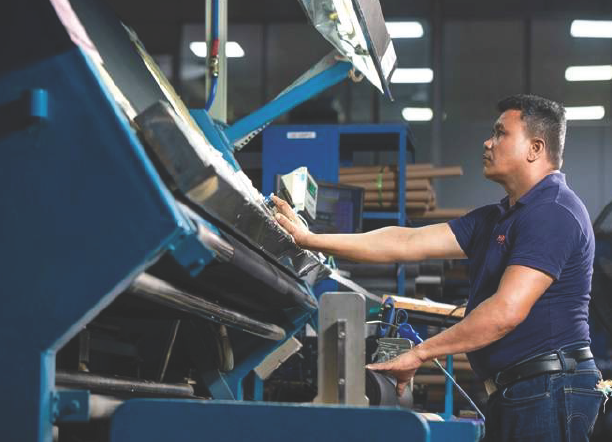
The company is also addressing bottlenecks in dyeing capacity. Proposals are in place for the addition of new bulk dyeing machines as well as the modernisation and replacement of existing equipment. These investments are expected to improve process flow and increase overall throughput.
Sustainability Becomes a Competitive Advantage
Sustainability is another major pillar of Teejay’s strategy, guided by its Abhivarah 2030 roadmap.
Despite a challenging financial year, the Group continued investing in renewable energy and emissions reduction. It advanced its biomass transition programme and a 7.2 MW solar project, while completing Phase I of the PNG transition initiative at Teejay India.
Across the Group, a 7 MW rooftop solar photovoltaic system has been commissioned, with the potential to reduce energy costs by 25–30% while lowering dependence on grid electricity. The investment also supports the Group’s target of reducing Scope 1 and 2 emissions by 42% by 2030.
The sustainability performance of the manufacturing operations has also been independently recognised. Teejay Lanka and Teejay India achieved 99% scores in the HiggFacility Environmental Module 2025 assessment, placing both among the Group’s strongest-performing facilities.
India as a Global Supply-Chain Hub
The importance of India goes beyond its production capacity. Teejay sees the country as a strategic component of its global risk-management and customer-service model.
India’s location provides access to one of the world’s largest textile and apparel ecosystems, while its proximity to major apparel manufacturing centres provides advantages in raw-material sourcing and customer responsiveness.
At the same time, India’s position in global trade is evolving rapidly. As brands reassess their sourcing strategies in response to geopolitical tensions, tariffs and supply-chain risks, Teejay’s Indian facility can become an increasingly important alternative manufacturing base.
The Group’s ability to combine Indian production with facilities in Sri Lanka, Bangladesh, Egypt and Indonesia gives it an unusual degree of flexibility.
New Global Growth Engines
While India remains a major strategic focus, Teejay is also expanding into new geographical markets.
The operationalisation of facilities in Egypt and Indonesia provides the Group with proximity to emerging apparel manufacturing hubs in Africa and ASEAN. These locations are expected to help Teejay shorten lead times, improve regional customer engagement and capture new orders generated by supply-chain realignment.
This geographic diversification is becoming increasingly important as global brands seek to de-risk supply chains and explore alternatives to traditional manufacturing centres.
The Group therefore sees its international footprint not as a collection of independent operations but as an interconnected manufacturing network capable of responding to changing sourcing patterns.
Outlook: From Fabric Manufacturer to Solutions Partner
Teejay’s future strategy is centred on making the organisation more agile, digital and innovation-driven.
The company intends to further upgrade its ERP systems, expand IoT integration, and deploy advanced analytics and automation across its facilities.
At the same time, the product strategy will continue moving towards complex, high-value and solution-driven fabrics, including performance and functional textiles.
For India, this creates a particularly promising opportunity. With a 55-tonne-per-day manufacturing facility, growing synthetic utilisation, advanced digital manufacturing capabilities and an established export-oriented location, Teejay India is well positioned to become an increasingly important node in the Group’s global manufacturing network.
The difficult 2025/26 financial year tested the company’s resilience, but it also accelerated structural changes. As the Group’s leadership notes, Teejay emerges from the period “more agile and geographically better positioned to capitalise on the structural shifts reshaping the global apparel supply chain.”
With global brands continuing to diversify sourcing, demand gradually recovering and the shift towards higher-value and sustainable textiles gathering pace, India is likely to play an increasingly central role in Teejay’s next chapter of growth.