


Hemp is steadily moving from a sustainability-led niche towards a commercially viable fibre for mainstream textile manufacturing, and Heartland USA is seeking to accelerate this transition through scalable fibre solutions and strategic blends. Its recent innovation combining US-grown Imperium hemp fibre with Supima® cotton demonstrates the potential to integrate hemp into commercial spinning systems while creating premium textile possibilities around performance, natural fibres and a distinctive “Grown in America” proposition. According to Mr. Amey Padma, Head – India Business, Heartland USA, the next phase of hemp adoption will depend on consistent fibre quality, reliable supply, technical compatibility and, ultimately, commercial economics.
Hemp is gaining renewed attention as textile manufacturers and global brands search for natural fibre alternatives that can deliver sustainability as well as commercially relevant performance. For Heartland USA, the opportunity extends beyond positioning hemp as another sustainable fibre. The company is focused on making hemp compatible with existing textile manufacturing infrastructure and developing commercially viable fibre blends for apparel and home textiles.

According to Mr. Amey Padmas, the global hemp market is gradually moving “from niche to industrial”, particularly through applications involving cotton, lyocell and other fibre blends.
However, he believes that mainstream adoption will ultimately depend on three factors: consistency, economics and supply reliability.
“Sustainability gets attention; performance and economics drive adoption,” says Padma.
Moving Hemp from Niche to Mainstream
The commercialisation of hemp in textiles depends heavily on its ability to meet the technical requirements of modern spinning and downstream processing.
For large-scale adoption, manufacturers need consistent fibre fineness, length, strength, cleanliness and spinnability, supported by dependable availability. Hemp cannot remain a specialised fibre that is difficult to source or requires entirely different manufacturing infrastructure.
Heartland’s approach is therefore centred on making hemp work within existing textile systems. Rather than positioning hemp solely as a sustainability story, the company is developing fibre platforms that can produce commercially viable yarns and fabrics.
Blending is emerging as an important route. By combining hemp with cotton, lyocell and other fibres, manufacturers can engineer specific combinations of comfort, strength, hand feel, durability and sustainability.
India: A Strategic Manufacturing Hub
India occupies a particularly important position in Heartland’s strategy because of the depth and breadth of its textile manufacturing ecosystem.
The country offers integrated capabilities across spinning, weaving, knitting, processing and garment manufacturing, while Indian mills also have extensive experience in fibre blending.
“Indian mills have strong expertise in fibre blending, making India an ideal development platform for hemp–cotton, hemp–cellulosic and other engineered blends,” says Padma.
Heartland’s objective is to leverage this manufacturing strength to convert US-grown hemp fibre into scalable yarns, fabrics and finished textile products for global markets.
The company is also addressing one of the practical barriers to hemp adoption: availability.
Unlike cotton, which is readily available through established textile supply chains, hemp fibre is not yet an off-the-shelf material for most Indian mills. Heartland plans to address this through an India-based warehouse model, enabling mills to access US-grown hemp fibre locally.
The proposition includes just-in-time availability, India billing, no minimum order quantity and technical support, while eliminating the customs-related complications associated with importing small quantities of fibre.
The objective is to make hemp as accessible to a textile manufacturer as possible without requiring changes to existing spinning machinery.
Connecting US-Grown Fibre with Indian Manufacturing
Heartland sees the combination of US-grown hemp and India’s textile manufacturing capabilities as an important component of its global strategy.
US-grown hemp provides a defined fibre origin and establishes the foundation for farm-to-fibre traceability. India, meanwhile, provides the manufacturing infrastructure required to convert the fibre into commercial textile products.
The long-term objective is to establish a controlled and scalable fibre-to-yarn-to-fabric-to-garment ecosystem, supported by consistent specifications, quality and supply reliability.
This model also provides an opportunity to connect agricultural origin more closely with downstream textile manufacturing, an increasingly important consideration for global brands seeking greater transparency in their material supply chains.
Imperium Fibre and Supima: Combining Two US-Grown Fibres
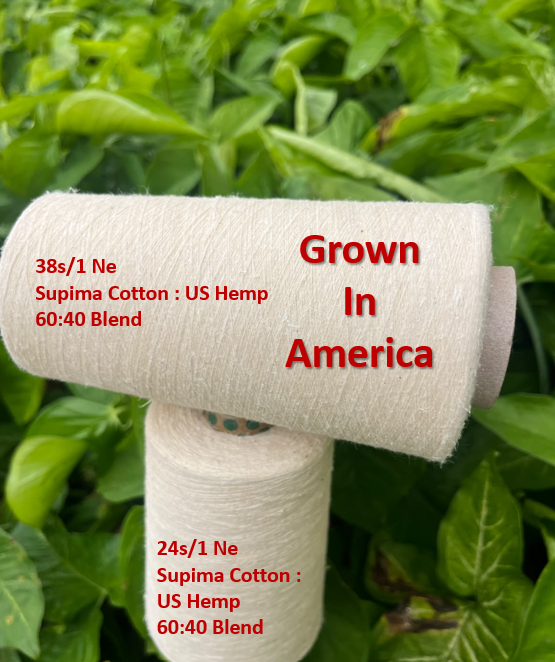
One of Heartland’s recent areas of innovation is the development of a blended-yarn platform combining its Imperium Fibre, produced from US-grown hemp, with Supima® cotton.
For Heartland, the significance extends beyond the creation of another fibre blend. The key achievement is demonstrating that hemp can be engineered into a blend that works within commercial spinning systems.
“The key achievement is demonstrating that hemp can be engineered into a blend that works within commercial spinning systems, rather than remaining a laboratory concept,” explains Padma.
The combination brings together US-grown hemp and premium Supima cotton, creating a strong “Grown in America” proposition for textile products.
The platform could support differentiated premium applications including apparel, shirting, knitwear and home textiles, particularly where brands are seeking natural fibres alongside performance, material differentiation and a compelling origin story.
Hemp’s Opportunity Lies in Engineered Blends
While hemp has inherent durability and strength characteristics, Heartland believes its greatest commercial opportunity may lie in its use as a component of engineered blends rather than necessarily as a standalone fibre.
Blending enables manufacturers to balance the characteristics of different fibres and develop products tailored to specific applications.
Hemp can contribute strength and durability, while the combination with cotton or cellulosic fibres can help achieve the required comfort, hand feel and processing characteristics.
This approach also allows brands to introduce hemp into products without fundamentally changing established manufacturing processes.
For textile manufacturers, the ability to use hemp within existing spinning systems is therefore an important consideration in determining how quickly the fibre can move from niche applications towards larger-scale adoption.
Traceability Beyond Sustainability Claims
As sustainability becomes increasingly integrated into sourcing decisions, Heartland is focusing on material-level traceability.
The company aims to maintain visibility from US-grown hemp through fibre processing and downstream textile manufacturing. Fibre origin, processing route, composition and manufacturing stages can provide the data required for more credible sustainability reporting.
Padma believes the industry needs to move beyond broad sustainability claims towards measurable and verifiable information.
“The industry needs to move from broad sustainability claims toward measurable, traceable and verifiable data across the textile value chain,” he says.
This approach could become increasingly important as global brands seek greater transparency around the origin and environmental characteristics of the materials incorporated into their products.
Overcoming the Adoption Barrier
Despite the potential, hemp faces several challenges before it can become a mainstream textile fibre.
The first is availability and consistency. Commercial adoption requires reliable volumes with consistent fineness, length, strength and processing characteristics.
The second is technical know-how. Hemp requires appropriate fibre preparation, blending and spinning parameters, while cost competitiveness will need to improve as volumes increase.
Most importantly, successful pilot projects need to evolve into repeatable commercial programmes. Mills and brands need confidence that the fibre will be available consistently and that the resulting yarn and fabric quality can be maintained over time.
Heartland’s India warehouse and technical-support model is intended to address several of these barriers simultaneously — providing access to fibre without large minimum orders, customs-related complexity or the need for significant changes to existing spinning machinery.
Building the Hemp Textile Ecosystem
Over the next three to five years, Heartland plans to scale its fibre platform by building reliable supplies of US-grown hemp and expanding its applications across textiles.
A major focus will be the development of new blend platforms, including hemp–cotton, hemp–cellulosic and hemp–wool, targeting apparel and home-textile applications.
The company also intends to work closely with Indian mills, manufacturers and global brands to establish a scalable fibre-to-yarn-to-fabric supply chain.
For Heartland, the larger opportunity is therefore not simply to sell hemp fibre, but to build the ecosystem required to make hemp easier to source, process and commercialise.
As Padma puts it, the objective is to move hemp towards mainstream textile production, with India playing a central role in converting US-grown fibre into commercially scalable textile products for global markets.