


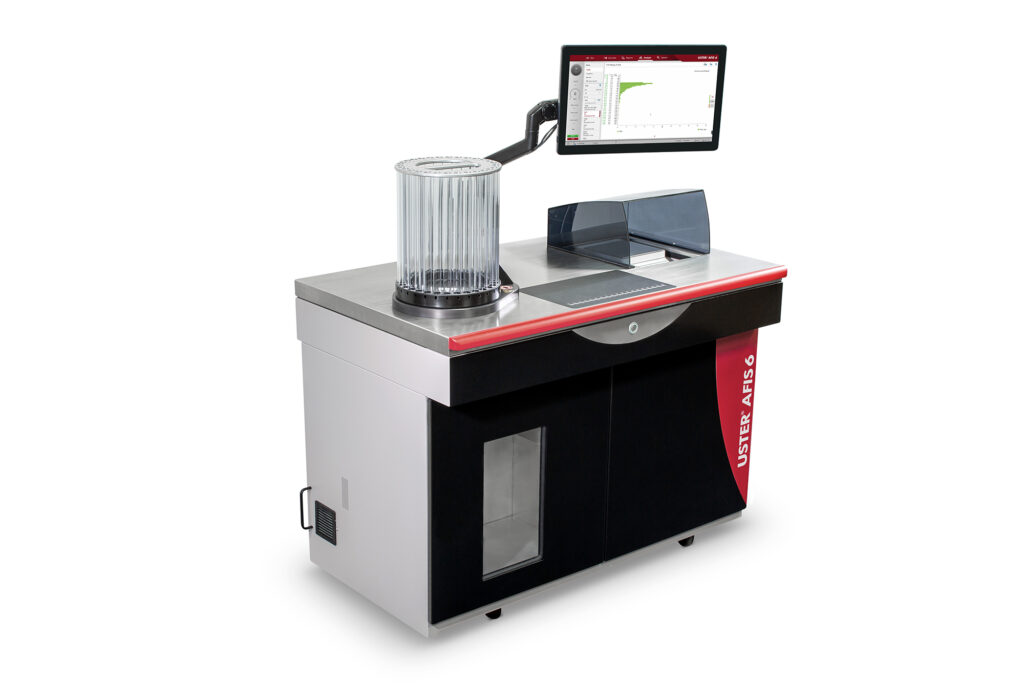
Uster AFIS 6 now offers the key data for better decisions when blending recycled fibers. Process control is decisive in determining the quality and economic outcome. The new R Recycling Module of AFIS 6 introduces the Recycling Opening Index (ROI), so spinners can optimize their circularity credentials. It is officially launched at ITM 2026 in Istanbul, Türkiye.
Cotton recycling has become a strategic priority for brands, regulators, and technology providers because it directly addresses the textile sector’s biggest challenges: growing volumes of waste, resource scarcity, climate impact, and regulatory pressure.
Recycled waste and the use of it
Recent industry data shows that most textile waste is post-consumer waste (75% by volume) while post-industrial (pre-consumer) waste makes up around 25%. However, when it comes to recycling – turning this waste into quality new yarn – the situation is different.
Even though it’s a smaller share of total waste, about 95-99% of post-industrial waste is already being reused. Almost every scrap of factory waste is already being collected and spun back into yarn. That’s because it’s clean, consistent, and relatively easy to process.
Spinners generally see it as the safer option to start their recycling activities with post-industrial waste. These raw materials are more predictable in their behaviour, so it’s simpler to refine spinning techniques to suit them. An optimized process can then be developed for blending in pre- and/or post-consumer waste.
Controlling processes with recycled raw materials
Now, objective measurement data from Uster is available to give clear indicators of processability and profitability when using recycled raw materials. This comes with the Recycling Opening Index (ROI), together with the total yarn pieces value. The ROI is a metric in the Uster AFIS 6 R Recycling Module, which describes the effectiveness of the opening process in the recycling of cotton fibers. It is defined as the ratio of opened fibers to remaining yarn pieces (hard ends). ‘Total yarn pieces’ means the sum of yarn fragments present in the raw material that have not yet been fully opened into individual fibers.
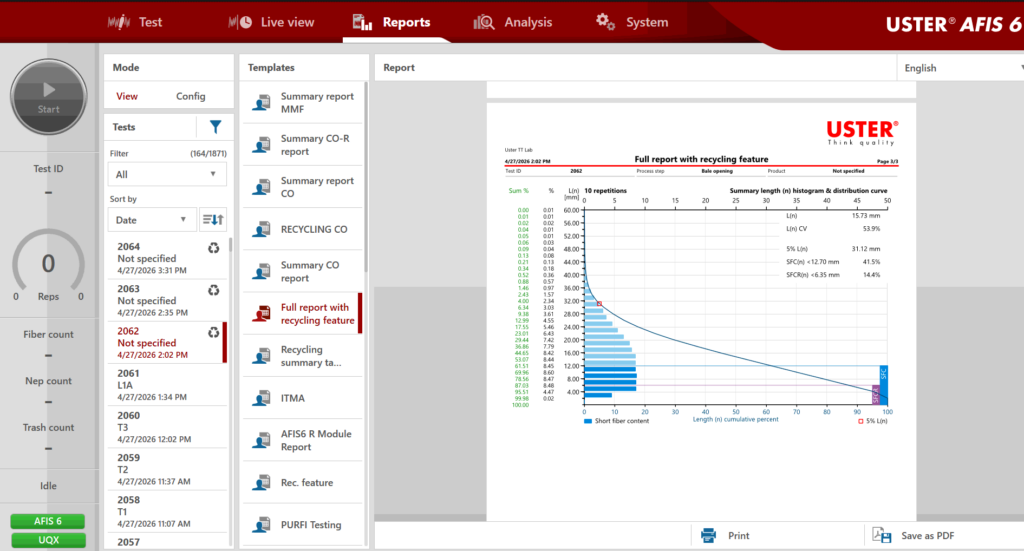
histogram and distribution curve.
If a low ROI value is indicated, this suggests a poor degree of opening, which can disrupt the spinning process and cause issues such as yarn irregularity (IPI), weak spots and uneven surface structures.
So, the ROI is a vital metric for evaluating the quality of recycled cotton materials. For the first time, spinners can have a quantitative assessment of the opening process.
R Recycling Module of Uster AFIS 6
Uster AFIS 6 with the R Recycling Module supports better decisions through real measurements. The concept of the Recycling Opening Index (ROI) combined with the number of yarn pieces per gram, provides spinners with a more precise evaluation of recycled material processing. The R Recycling Module also offers advanced recycling parameter measurements, as well as a refined short fiber content analysis with < 6.35 mm indicating the non-spinnable fiber content. In addition, the module enhances fiber quality assessment by incorporating detailed nep and fiber length parameters. The R Recycling Module on AFIS 6 is an optional, on-demand feature designed exclusively for this latest model.
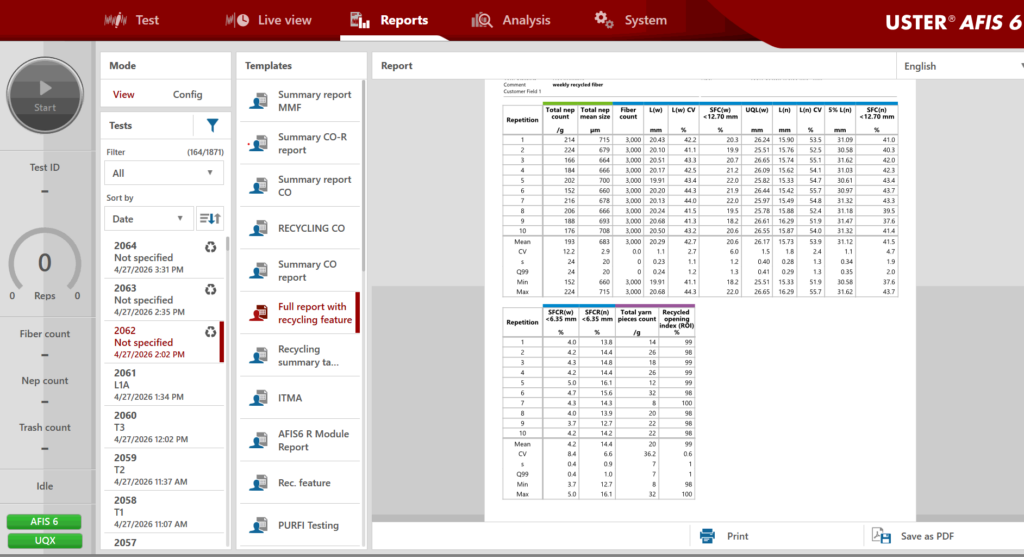
and yarn pieces/gr).
The new module fits perfectly within Uster AFIS 6, with its expanded measurement range for 100% synthetic fibers giving details of cut length and denier/fineness, to help spinners make proper raw material selections. The updated reporting package simplifies complex data analysis, and the integrated Uster Statistics remains the essential tool for spinners to optimize intermediate process steps – finally empowering full control of their processes.