


By Jayshri Ramani
Dyne Chemical Focuses on Innovation, Sustainability and Application Excellence
In today’s rapidly evolving textile industry, chemistry has emerged as a critical driver of performance, efficiency, and sustainability. From pre-treatment and dyeing to finishing and functional enhancements, textile chemicals play a decisive role in determining fabric quality, durability, compliance, and value addition. As global brands and buyers demand higher standards of consistency, eco-compliance, and performance, textile processors are increasingly relying on advanced chemical solutions to meet these expectations.
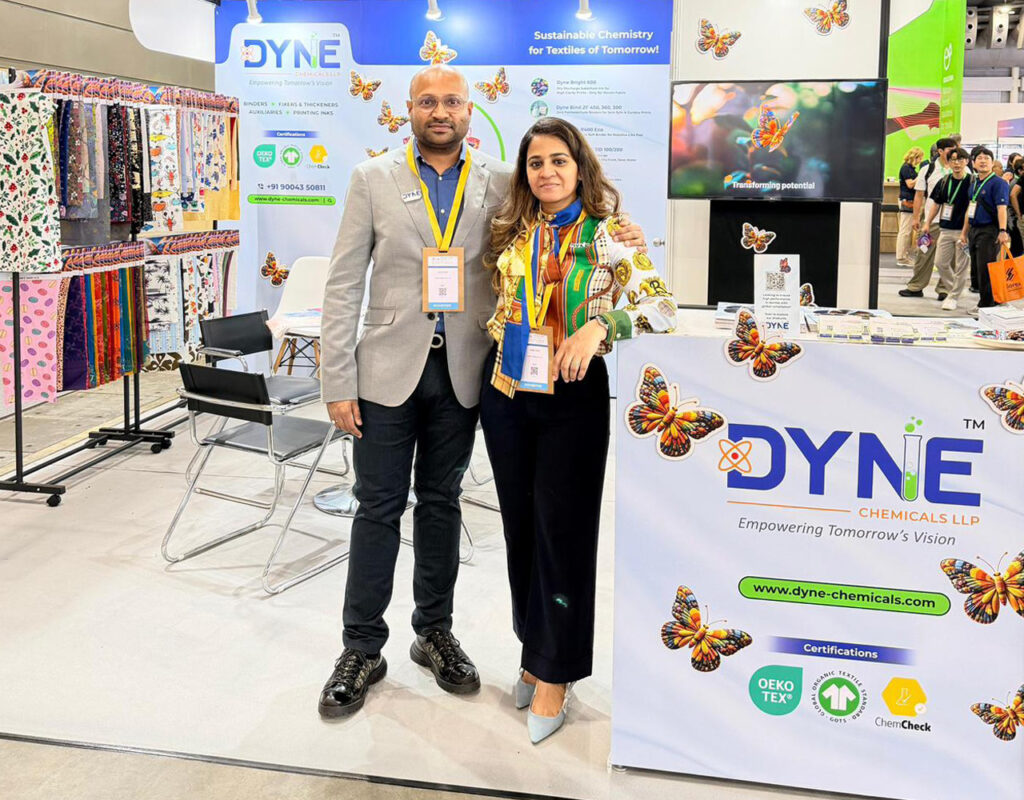
At the forefront of this transformation is Dyne Chemical, a company committed to delivering innovative and sustainable chemical solutions for the textile industry. Under the leadership of Mr. Yash Patel, Managing Director, Dyne Chemical has positioned itself as more than just a supplier of chemicals, evolving into a solution partner for textile manufacturers seeking to enhance quality, productivity, and sustainability.
Driving Performance Through Innovation
According to Mr. Patel, textile chemicals have evolved far beyond their traditional role in processes such as scouring, bleaching, and dyeing. Modern formulations are increasingly designed to improve fabric functionality, optimize processing efficiency, and ensure consistent quality across production batches.
Today’s textile market demands fabrics that offer superior color fastness, moisture management, softness, durability, and wash performance. Meeting these expectations requires specialized and application-specific chemical solutions that address both performance and process challenges. Dyne Chemical works closely with textile processors to understand production requirements and develop solutions that improve operational efficiency while delivering superior end-product quality.
The company follows a structured product development approach involving laboratory formulation, pilot-scale evaluation, and large-scale mill trials. Extensive testing across cotton, polyester, viscose, and blended fabrics ensures that products consistently meet performance benchmarks related to shade reproducibility, fabric hand feel, fastness properties, and process compatibility.
Sustainability and Technical Excellence
Sustainability has become a defining factor in global textile manufacturing. International standards and regulations such as ZDHC, REACH, and various restricted substance lists have fundamentally changed the way textile chemicals are developed and utilized.
Recognizing this shift, Dyne Chemical has focused its efforts on creating environmentally responsible solutions that reduce water and energy consumption, lower effluent loads, improve chemical utilization efficiency, and support cleaner production processes. The company’s emphasis on eco-friendly and biodegradable formulations aligns with the growing sustainability commitments of textile brands and manufacturers worldwide.
At the same time, the company sees significant opportunities in the rapidly growing technical textiles segment. Applications such as medical textiles, automotive fabrics, protective clothing, geotextiles, and industrial textiles require highly specialized chemical technologies capable of delivering precise performance characteristics. As India strengthens its position in technical textiles, advanced chemistry will play a crucial role in supporting this growth.
Addressing Industry Challenges and Future Opportunities
Despite the industry’s progress, several challenges continue to influence textile processing operations. Technical skill gaps, raw material price volatility, increasing compliance requirements, and the pace of technological change require continuous adaptation from both manufacturers and solution providers.
Dyne Chemical addresses these challenges through a customer-centric development approach. Continuous engagement with textile mills allows the company to identify real-world production issues such as uneven dyeing, foam management, process stability, and wash fastness, and develop targeted solutions that improve manufacturing outcomes.
Looking ahead, the company plans to further strengthen its portfolio of sustainable products, expand its presence in technical textiles, enhance its research and development capabilities, and pursue greater collaboration with global partners. These initiatives are aimed at supporting the textile industry’s transition toward more sustainable, efficient, and performance-driven manufacturing.
Summing up his vision for the industry, Mr. Yash Patel remarks:
“The textile industry is entering a new phase defined by sustainability, performance, and global compliance. Chemical innovation is becoming central to this transformation.”